

Introduction
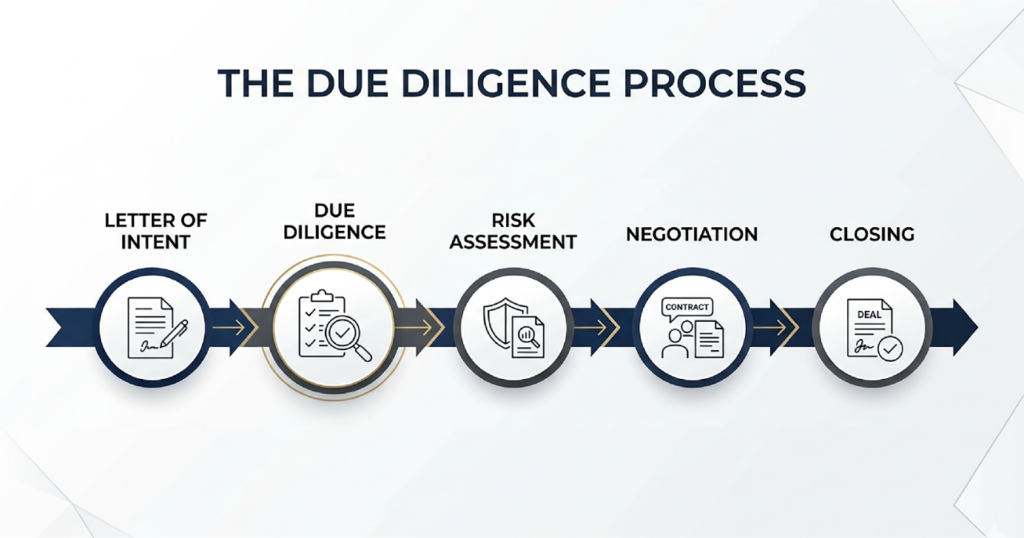
Receiving a Letter of Intent (LOI) is an exciting milestone for any business owner. It signals that a buyer has expressed serious interest in acquiring your company and is willing to move forward with the transaction. However, many owners mistakenly believe that once the LOI is signed, the hardest part of the sale is over.
In reality, the most critical phase is just beginning.
Due diligence is where buyers verify every financial, operational, legal, and commercial claim made about your business. It’s the stage where assumptions are tested, risks are uncovered, and the final purchase price is either confirmed-or renegotiated. Even businesses with strong financial performance can see deals delayed, restructured, or terminated if unexpected issues emerge during this process.
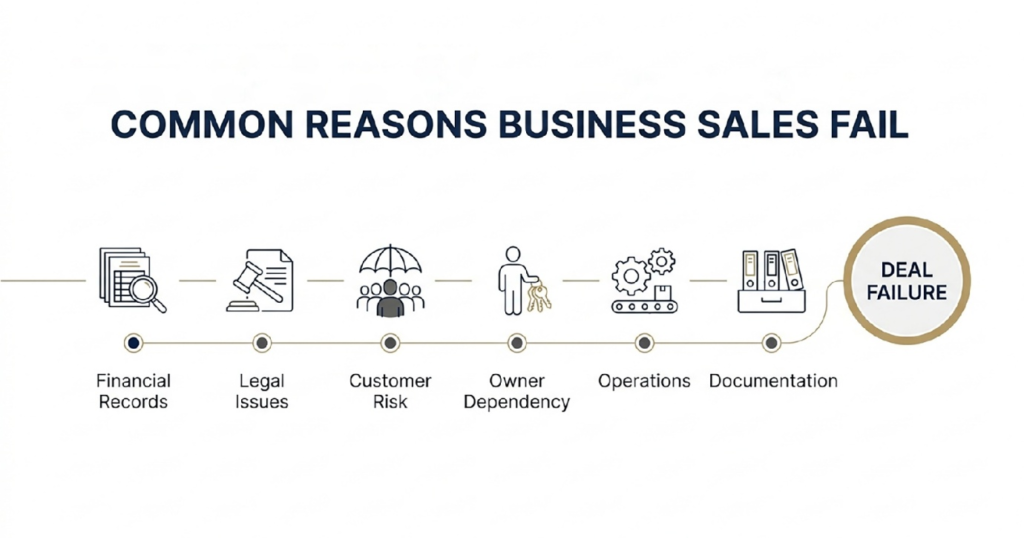
Industry experience consistently shows that a significant number of lower middle market transactions fail after the LOI, often due to problems that could have been identified and resolved long before the business went to market. Poor financial reporting, customer concentration, legal issues, owner dependency, and incomplete documentation are just a few of the challenges that can undermine buyer confidence.
The good news is that most due diligence issues are preventable with proper planning.
In this guide, we’ll explore the ten most common reasons business sales fail during due diligence, explain how buyers evaluate risk, and share practical strategies to help you prepare for a smoother, more successful transaction.
What Is Due Diligence and Why Does It Matter?
Due diligence is the comprehensive investigation a buyer performs before completing the purchase of a business. Its purpose is simple: verify that the business is worth what the buyer has agreed to pay and ensure there are no hidden risks that could impact future performance.
Think of it as a financial and operational health check. During this stage, buyers review virtually every aspect of the company, including:
- Financial statements
- Tax filings
- Customer contracts
- Supplier agreements
- Employee information
- Legal records
- Intellectual property
- Operational processes
- Technology systems
- Regulatory compliance
Depending on the size and complexity of the transaction, the due diligence process typically lasts between 30 and 90 days, although larger or more complex deals may take longer.
While buyers hope to confirm the value they saw during initial negotiations, they’re also looking for anything that could reduce future cash flow, increase operational risk, or create legal liabilities. If significant issues are discovered, buyers may:
- Reduce the purchase price
- Request escrow holdbacks
- Negotiate earn-out provisions
- Delay closing
- Walk away from the deal entirely
For sellers, transparency and preparation are essential. Businesses that maintain organized records, respond quickly to requests, and proactively address potential issues tend to complete transactions faster and with fewer valuation adjustments.
The 10 Most Common Reasons Businesses Fail During Due Diligence
1. Poor Financial Records
Financial statements are the foundation of every acquisition. Buyers rely on them to evaluate profitability, cash flow, working capital, and future earnings potential.
Unfortunately, many businesses maintain financial records that are incomplete, inconsistent, or poorly organized. Common issues include:
- Financial statements that don’t reconcile with tax returns
- Inconsistent bookkeeping practices
- Missing monthly financial reports
- Personal expenses mixed with business expenses
- Lack of supporting documentation for major transactions
When buyers encounter unreliable financial information, their confidence in the business quickly declines. Even if the underlying business is healthy, uncertainty increases perceived risk-and perceived risk almost always affects valuation.
How to Avoid It
- Maintain accurate monthly financial statements.
- Reconcile accounts regularly.
- Separate personal and business expenses.
- Work with experienced accounting professionals.
- Conduct an internal financial review before going to market.
Businesses with clean financial reporting not only move through due diligence more efficiently but also command greater buyer confidence.
2. Overstated EBITDA
One of the most common reasons buyers renegotiate purchase prices is discovering that reported EBITDA doesn’t accurately reflect the company’s true earnings.
Many sellers include aggressive or unsupported EBITDA add-backs, such as:
- Personal expenses without documentation
- One-time costs that are actually recurring
- Inflated owner compensation adjustments
- Temporary cost reductions
- Revenue that cannot reasonably be expected to continue
Professional buyers frequently perform a Quality of Earnings (QoE) analysis to validate normalized EBITDA. If adjustments cannot be substantiated, buyers typically recalculate earnings using more conservative assumptions.
A seemingly small reduction in EBITDA can significantly impact valuation. For example, reducing normalized EBITDA by $500,000 in a business valued at an 8x multiple could lower the purchase price by approximately $4 million.
How to Avoid It
- Document every EBITDA adjustment.
- Support add-backs with invoices, payroll records, or contracts.
- Avoid overly aggressive normalization assumptions.
- Consider obtaining a pre-sale Quality of Earnings review.
Buyer Perspective
Buyers are not looking for perfection-they’re looking for predictability. Every unsupported financial adjustment creates uncertainty, and uncertainty translates directly into lower valuations, additional deal terms, or increased buyer protections.
3. Customer Concentration Risk
Revenue concentration is one of the first commercial risks buyers evaluate.
If a single customer accounts for 30%, 40%, or even 50% of annual revenue, the buyer faces significant risk. Losing that customer after closing could dramatically reduce profitability and business value.
Customer concentration often leads buyers to ask questions such as:
- How long has this customer been with the company?
- Is there a written contract?
- What is the likelihood of renewal?
- Could the customer leave after ownership changes?
- What happens if this customer is lost?
Even profitable businesses may receive lower valuation multiples if revenue is heavily dependent on one or two customers.
How to Avoid It
- Diversify your customer base well before selling.
- Secure long-term customer contracts where possible.
- Reduce reliance on any single client.
- Demonstrate recurring revenue from multiple sources.
A diversified revenue base gives buyers greater confidence in future cash flow.
4. Owner Dependency
Many privately owned businesses rely heavily on the founder or owner for daily operations, customer relationships, strategic decision-making, and sales.
From a buyer’s perspective, this creates significant transition risk.
If the owner leaves after closing, will customers stay? Will employees know how to operate the business? Can management continue generating revenue independently?
The more essential the owner is to daily operations, the more difficult it becomes for buyers to justify paying a premium valuation.
How to Avoid It
Reduce owner dependency by:
- Delegating operational responsibilities.
- Building a strong leadership team.
- Documenting standard operating procedures.
- Developing succession plans.
- Empowering department managers.
Businesses that can operate successfully without the owner are generally more valuable and easier to sell.
5. Legal and Compliance Issues
Legal issues often surface during due diligence, even in businesses that appear well-managed.
Buyers and their legal advisors carefully review:
- Corporate records
- Customer contracts
- Supplier agreements
- Employment agreements
- Intellectual property ownership
- Licenses and permits
- Insurance coverage
- Pending litigation
- Regulatory compliance
Problems such as expired licenses, unsigned contracts, unresolved lawsuits, or missing corporate documentation can delay closing-or stop a transaction altogether.
Even relatively minor legal issues can create uncertainty if buyers believe additional liabilities may exist.
How to Avoid It
- Conduct a legal review before marketing your business.
- Ensure contracts are signed and current.
- Resolve outstanding disputes early.
- Verify compliance with industry regulations.
- Organize all corporate records in a secure data room.
Being proactive demonstrates professionalism and reduces unnecessary buyer concerns.
Common Mistake
Many business owners wait until after receiving an offer to organize financial records, contracts, and legal documents. By then, buyers are already evaluating the business, and delays or missing information can quickly erode confidence. The best time to prepare for due diligence is 12–24 months before going to market, not after signing an LOI.
6. Weak Operational Processes
Strong financial performance is important, but buyers also want confidence that the business can continue performing after the current owner exits. During due diligence, they evaluate how efficiently the company operates and whether its processes are scalable.
Businesses without documented systems often depend on tribal knowledge-information stored in the minds of long-serving employees rather than in formal procedures. This creates uncertainty and increases transition risk.
Common operational weaknesses include:
- No documented Standard Operating Procedures (SOPs)
- Manual workflows that rely heavily on individuals
- Limited reporting or performance dashboards
- Poor inventory controls
- Outdated software and technology
- Lack of key performance indicators (KPIs)
Operational inefficiencies don’t always stop a deal, but they often reduce buyer confidence and provide leverage for negotiating a lower purchase price.
How to Avoid It
- Document all critical business processes.
- Implement reliable reporting systems.
- Automate repetitive tasks where practical.
- Track KPIs consistently.
- Demonstrate operational scalability.
A business with repeatable systems is far easier for a buyer to integrate and grow.
7. Employee and Management Risks
People are often a company’s greatest asset-and one of its greatest risks.
Buyers want to understand whether the business has a capable management team that can maintain performance after the acquisition. If success depends on one or two key employees, the buyer assumes additional risk.
During due diligence, buyers commonly review:
- Organizational structure
- Employee retention history
- Compensation plans
- Employment agreements
- Non-compete and confidentiality agreements
- Succession planning
High employee turnover, unresolved HR issues, or uncertainty around key personnel can negatively impact the transaction.
How to Avoid It
Strengthen your organization before going to market by:
- Retaining key employees.
- Developing future leaders.
- Cross-training critical roles.
- Creating incentive or retention plans.
- Formalizing employment agreements.
Businesses with experienced management teams are generally viewed as more stable and command stronger valuations.
8. Incomplete Documentation
One of the fastest ways to slow down due diligence is failing to provide requested information.
Buyers expect organized documentation, not a last-minute scramble through filing cabinets and email folders.
Missing documents commonly include:
- Tax returns
- Customer contracts
- Supplier agreements
- Corporate minutes
- Lease agreements
- Insurance policies
- Equipment records
- Loan documents
- Intellectual property registrations
Each missing document creates additional questions. More questions mean longer diligence timelines, increased professional fees, and growing buyer frustration.
How to Avoid It
Before taking your business to market:
- Build a secure virtual data room.
- Organize documents by category.
- Review records for completeness.
- Update expired agreements.
- Assign one person to manage document requests.
Preparation demonstrates professionalism and allows buyers to move through diligence efficiently.
9. Declining Business Performance During the Sale Process
Many business owners focus so heavily on selling that they unintentionally neglect running the business.
Buyers closely monitor performance between the LOI and closing. Even a few months of declining results can trigger concerns.
They look for trends such as:
- Falling revenue
- Shrinking gross margins
- Declining EBITDA
- Customer losses
- Reduced sales pipeline
- Deteriorating working capital
Buyers value businesses based on future earnings potential-not just historical performance. If performance weakens during diligence, buyers may conclude that the business is less valuable than originally believed.
How to Avoid It
- Keep management focused on daily operations.
- Continue investing in sales and marketing.
- Maintain customer relationships.
- Monitor monthly financial performance.
- Address negative trends immediately.
A stable or improving business performance reinforces buyer confidence and protects valuation.
10. Poor Due Diligence Preparation
The most common reason transactions become stressful is simple: preparation starts too late.
Many owners don’t begin organizing financial records, contracts, and operational information until after accepting an LOI. At that point, buyer requests become urgent, advisors are under pressure, and avoidable mistakes begin to surface.
Poor preparation often results in:
- Slow responses to buyer requests
- Missing documents
- Inconsistent information
- Repeated follow-up questions
- Extended closing timelines
- Renegotiated purchase prices
Experienced buyers interpret poor organization as a sign that additional problems may exist-even when they don’t.
How to Avoid It
Begin preparing 12–24 months before a planned sale by:
- Conducting a sell-side due diligence review.
- Organizing a secure virtual data room.
- Identifying operational, financial, and legal risks.
- Resolving issues before buyers discover them.
- Working with experienced M&A advisors throughout the process.
The best transactions are rarely the ones with perfect businesses-they’re the ones with well-prepared sellers.
Real-World Due Diligence Scenario
A privately owned manufacturing company accepted a $18 million Letter of Intent after a competitive sale process.
On the surface, the business appeared healthy. Revenue had grown consistently, EBITDA margins were attractive, and buyer interest was strong.
However, during due diligence, several issues emerged:
- Revenue reports did not reconcile with financial statements.
- Nearly 46% of annual revenue came from a single customer.
- Several EBITDA add-backs lacked supporting documentation.
- Key customer agreements were unsigned or missing.
None of these issues made the business fundamentally worse than it had been when the LOI was signed. What changed was the buyer’s perception of risk.
After reassessing the business, the buyer reduced the purchase price by approximately $2.7 million and required additional escrow protections before agreeing to close.
The lesson is clear: buyers don’t pay premium valuations for uncertainty. Proper preparation before going to market often preserves significantly more value than attempting to fix issues during due diligence.
Summary: 10 Common Due Diligence Deal Killers
| Reason | Why Buyers Worry | How to Avoid It |
| Poor Financial Records | Lack of trust in reported performance | Maintain accurate, reconciled financial statements |
| Overstated EBITDA | Inflated valuation expectations | Support all EBITDA adjustments with documentation |
| Customer Concentration | Revenue risk if a major customer leaves | Diversify customers and secure long-term contracts |
| Owner Dependency | Business cannot operate independently | Build management depth and document processes |
| Legal & Compliance Issues | Potential liabilities and delays | Resolve legal issues and organize contracts |
| Weak Operational Processes | Difficult transition and scalability concerns | Document SOPs and implement reporting systems |
| Employee & Management Risks | Loss of key talent after closing | Develop succession plans and retain key employees |
| Incomplete Documentation | Delays and reduced buyer confidence | Build a well-organized virtual data room |
| Declining Business Performance | Reduced future earnings potential | Maintain operational focus throughout the sale |
| Poor Due Diligence Preparation | Increased uncertainty and negotiation risk | Start preparing 12–24 months before selling |
Seller Perspective
Many owners believe the hardest part of selling a business is finding the right buyer. In reality, the most challenging stage often begins after signing the Letter of Intent. Buyers use due diligence to verify every assumption behind their offer. Sellers who prepare early, organize their business, and address risks proactively are far more likely to protect their valuation and reach a successful closing.
Due Diligence Preparation Checklist
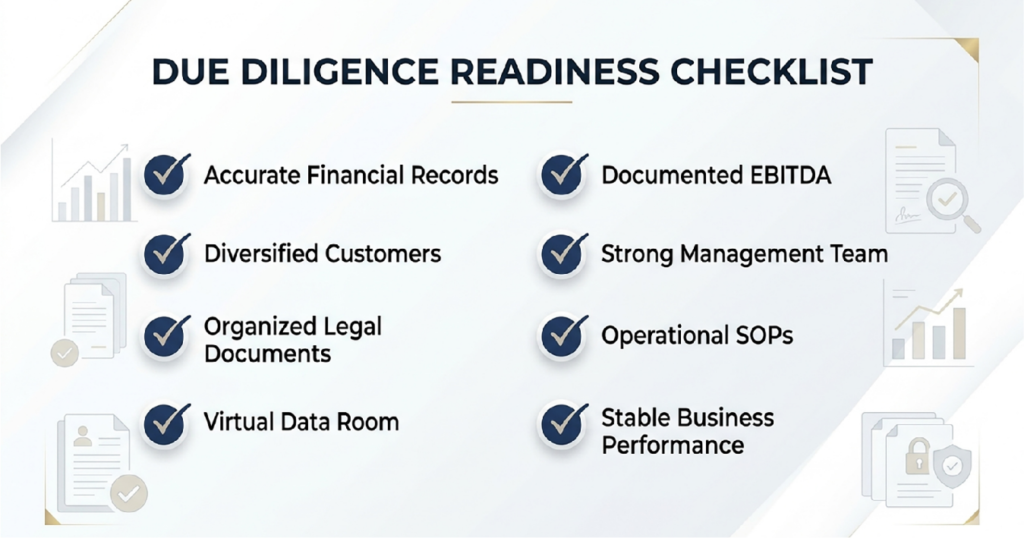
The difference between a smooth closing and a stressful, drawn-out transaction often comes down to preparation. Buyers expect sellers to provide accurate, organized, and readily accessible information. If documents are missing or responses are delayed, buyers may begin questioning whether additional risks exist.
The best time to prepare for business due diligence is 12–24 months before going to market. Early preparation gives you time to resolve issues, improve financial reporting, and present your business in the best possible light.
Use the following checklist as a starting point before beginning the sale process.
Financial Documents
- Three to five years of financial statements
- Federal and state tax returns
- Monthly profit and loss statements
- Balance sheets
- Cash flow statements
- Accounts receivable and payable aging reports
- Debt schedules
- Fixed asset register
- EBITDA reconciliation and supporting schedules
- Financial forecasts and budgets
Legal & Corporate Records
- Articles of Incorporation or Organization
- Shareholder or Operating Agreements
- Board meeting minutes
- Business licenses and permits
- Litigation history
- Insurance policies
- Lease agreements
- Loan documents
- Material customer and supplier contracts
Customer & Sales Information
- Customer list by revenue
- Customer concentration analysis
- Sales pipeline
- Major customer contracts
- Recurring revenue reports
- Customer retention metrics
Supplier Information
- Supplier agreements
- Vendor contracts
- Purchase commitments
- Pricing agreements
- Alternative supplier information
Employee & HR Documents
- Organizational chart
- Employee roster
- Compensation and benefits
- Employment agreements
- Non-compete and confidentiality agreements
- Employee handbook
- Retention plans for key personnel
Intellectual Property & Technology
- Trademarks
- Patents
- Copyrights
- Software licenses
- Domain ownership
- Cybersecurity policies
- IT infrastructure documentation
Operations
- Standard Operating Procedures (SOPs)
- Process documentation
- Inventory reports
- Equipment maintenance records
- Quality control procedures
- KPI dashboards
- Operational workflow documentation
Expert Tips for a Smoother Due Diligence Process
Due diligence doesn’t have to be overwhelming. Businesses that prepare early and stay organized are far more likely to maintain buyer confidence, avoid unnecessary delays, and protect their valuation.
Here are a few best practices followed by experienced sellers:
- Start Early: Begin preparing 12–24 months before planning to sell your business.
- Create a Secure Virtual Data Room: Organize all documents in one secure location before buyers request them.
- Be Transparent: Don’t hide issues. Buyers almost always discover them, and surprises can damage trust.
- Resolve Known Risks: Address legal disputes, accounting inconsistencies, compliance issues, and operational weaknesses before going to market.
- Respond Quickly: Timely responses demonstrate professionalism and keep the transaction moving.
- Keep Running the Business: Continue focusing on revenue growth and operational performance throughout the sale process.
- Work With Experienced Advisors: An experienced M&A advisor can identify potential deal risks before buyers do and guide you through negotiations.
Think like a buyer before you become a seller.
One of the most valuable exercises a business owner can undertake is a sell-side due diligence review. This internal assessment mirrors the questions and document requests buyers will make during the transaction. By identifying weaknesses early, you can fix problems on your timeline instead of negotiating under pressure after receiving an offer.
Businesses that conduct sell-side due diligence often experience:
- Faster due diligence timelines
- Fewer buyer objections
- Stronger negotiating positions
- Reduced purchase price adjustments
- Higher buyer confidence
Frequently Asked Questions
1. What is due diligence in a business sale?
Due diligence is the process buyers use to verify the financial, operational, legal, and commercial information about a business before completing an acquisition. It helps buyers confirm the company’s value and identify any risks that could affect the transaction.
2. How long does due diligence usually take?
For most lower middle market transactions, due diligence takes 30 to 90 days. Larger or more complex businesses may require additional time depending on the volume of documentation and the issues identified during the review.
3. What documents are required during due diligence?
Buyers typically request:
- Financial statements
- Tax returns
- Customer contracts
- Supplier agreements
- Employment records
- Legal and corporate documents
- Insurance policies
- Intellectual property records
- Operational procedures
- Financial forecasts
Preparing these documents in advance can significantly reduce delays.
4. Can a buyer reduce the purchase price during due diligence?
Yes. If buyers discover issues such as declining financial performance, unsupported EBITDA adjustments, customer concentration, or legal risks, they may renegotiate the purchase price or request different deal terms before closing.
5. Can a business sale fail after signing a Letter of Intent (LOI)?
Absolutely. An LOI outlines the preliminary terms of the transaction but is typically non-binding regarding the final purchase. Significant issues uncovered during due diligence can lead buyers to renegotiate-or walk away entirely.
6. Who manages the due diligence process?
The process is usually coordinated by the buyer’s M&A team, accountants, attorneys, and lenders. On the seller’s side, an experienced M&A advisor helps organize documentation, coordinate responses, manage communication, and keep the transaction on schedule.
7. How is confidential business information protected?
Most transactions begin with a Non-Disclosure Agreement (NDA). Sensitive information is typically shared through a secure virtual data room, where access can be controlled, monitored, and restricted to authorized parties.
8. Should I hire an M&A advisor for due diligence?
Yes. An experienced M&A advisor helps prepare your business before it goes to market, identifies potential risks, coordinates document requests, manages buyer communications, and helps protect your valuation throughout the transaction.
9. What is a Quality of Earnings (QoE) report?
A Quality of Earnings report is an independent financial analysis that verifies normalized EBITDA and evaluates the sustainability of a company’s earnings. Many sophisticated buyers use QoE reports to validate financial performance before completing an acquisition.
10. When should I start preparing for due diligence?
Ideally, preparation should begin 12–24 months before you plan to sell. This allows sufficient time to improve financial reporting, organize documentation, strengthen operations, and address issues before buyers begin their review.
Conclusion
Receiving a Letter of Intent is an important milestone-but it is not the finish line. Due diligence is where buyers verify every aspect of your business, assess risk, and determine whether the agreed purchase price is justified.
The good news is that most due diligence challenges are preventable. Clean financial records, well-documented operations, strong management, organized legal documentation, and early preparation can significantly improve buyer confidence and reduce the risk of delays, price reductions, or failed transactions.
Rather than waiting until an offer arrives, successful business owners prepare months-or even years-in advance. This proactive approach not only creates a smoother transaction but also helps preserve business value and strengthens your negotiating position.
If you’re considering selling your business in the next few years, now is the time to start preparing.
At Horizon M&A, we help business owners navigate every stage of the sale process-from business valuation and exit planning to sell-side due diligence, buyer negotiations, and successful closings. Our team works proactively to identify potential deal risks before buyers do, helping you maximize value and improve the likelihood of a successful transaction.
Ready to prepare your business for a successful sale? Contact Horizon M&A today for a confidential consultation and discover how early planning can help protect your company’s value.