

Introduction
If you’re planning to sell your business-whether that’s next year or five years from now-one question should be at the top of your mind:
What can I do today to make my business more valuable?
Many business owners assume that higher revenue automatically translates into a higher valuation. While strong financial performance certainly matters, it’s only one piece of the puzzle. Buyers look beyond the numbers to evaluate the quality of your business, the risks involved in acquiring it, and its ability to generate sustainable growth after the transaction closes.
This explains why two companies with similar revenue and EBITDA can receive significantly different acquisition offers. One may attract multiple competitive buyers and command a premium valuation, while the other struggles to justify its asking price.
At Horizon M&A, we’ve found that premium business valuations are rarely driven by a single factor. Instead, they’re the result of strong financial fundamentals, operational maturity, experienced leadership, recurring revenue, customer diversification, and careful preparation long before a business enters the market.
Understanding what buyers value gives business owners a competitive advantage. By improving the right areas before going to market, you can strengthen your negotiating position, reduce transaction risk, and maximize the value of your business.
In this guide, we’ll explain how buyers determine business value, the factors that consistently influence acquisition offers, and practical steps you can take to position your business for a successful sale.
Why Business Valuations Vary So Much
One of the biggest misconceptions among business owners is that valuation is based on a simple formula.
In reality, buyers don’t value businesses based solely on revenue, profit, or even EBITDA. While financial performance provides the foundation for a valuation, the final purchase price depends on how buyers assess the business’s future earning potential and overall level of risk.
Imagine two manufacturing companies that each generate:
- $12 million in annual revenue
- $2 million in EBITDA
- Similar products and market presence
On paper, they appear almost identical. Yet one business receives acquisition offers at 5x EBITDA, while the other attracts buyers willing to pay 7x EBITDA.
The difference isn’t the numbers-it’s the business behind the numbers.
Buyers evaluate questions such as:
- Can the business continue growing after the owner exits?
- Is revenue stable and predictable?
- Are customers diversified?
- Does the company have experienced management?
- Are financial records accurate and transparent?
- Is the business scalable?
- What risks could reduce future profitability?
Every positive answer reduces buyer risk and increases confidence, often leading to a higher valuation multiple.
Simply put, buyers aren’t paying for what your business has done in the past-they’re investing in what they believe it can achieve in the future.
Expert Insight: Business valuation is ultimately a balance between expected future returns and perceived risk. Businesses that reduce uncertainty and demonstrate sustainable growth typically command stronger acquisition offers.
How Buyers Determine Business Value
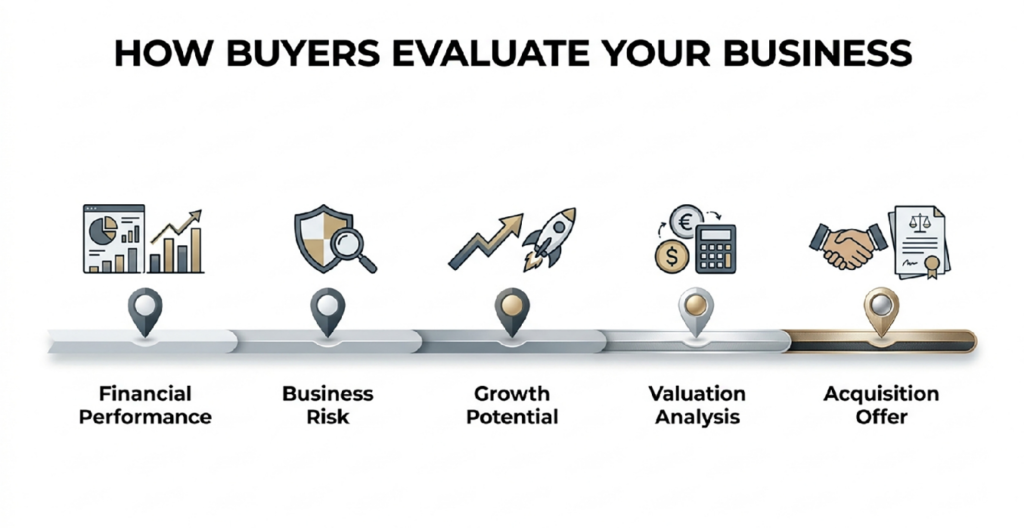
Before discussing what increases business value, it’s important to understand how buyers evaluate a company during an acquisition.
Most professional buyers follow a structured process rather than relying on instinct or rough estimates.
Step 1: Assess Financial Performance
The first step is reviewing historical financial performance.
Buyers analyze several years of:
- Revenue growth
- EBITDA
- Gross margins
- Cash flow
- Operating expenses
- Profit trends
They’re looking for consistency rather than one exceptional year.
Stable financial performance gives buyers confidence that earnings can continue after the acquisition.
Step 2: Evaluate Risk
Once financial performance has been established, buyers assess risk.
Questions commonly include:
- Is the business overly dependent on one customer?
- Does the owner make every important decision?
- Are there pending legal issues?
- Are financial records reliable?
- Can operations continue without the current owner?
The greater the perceived risk, the lower the valuation.
Conversely, businesses with predictable operations and fewer uncertainties generally receive stronger offers.
Step 3: Estimate Future Growth
Acquisitions are investments in future performance.
Buyers evaluate opportunities such as:
- Entering new markets
- Launching additional products
- Geographic expansion
- Cross-selling opportunities
- Margin improvement
- Operational efficiencies
Companies with significant growth potential often justify higher acquisition multiples because buyers expect stronger future returns.
Step 4: Apply a Valuation Method
Depending on the business, buyers may use one or more valuation approaches, including:
- EBITDA Multiple
- Revenue Multiple
- Discounted Cash Flow (DCF)
- Market Comparables
- Asset-Based Valuation
For profitable lower middle market businesses, EBITDA multiples remain one of the most widely used valuation methods.
However, the multiple itself isn’t fixed.
It’s influenced by dozens of qualitative and quantitative factors that reflect the overall strength of the business.
The Factors That Increase Business Valuations
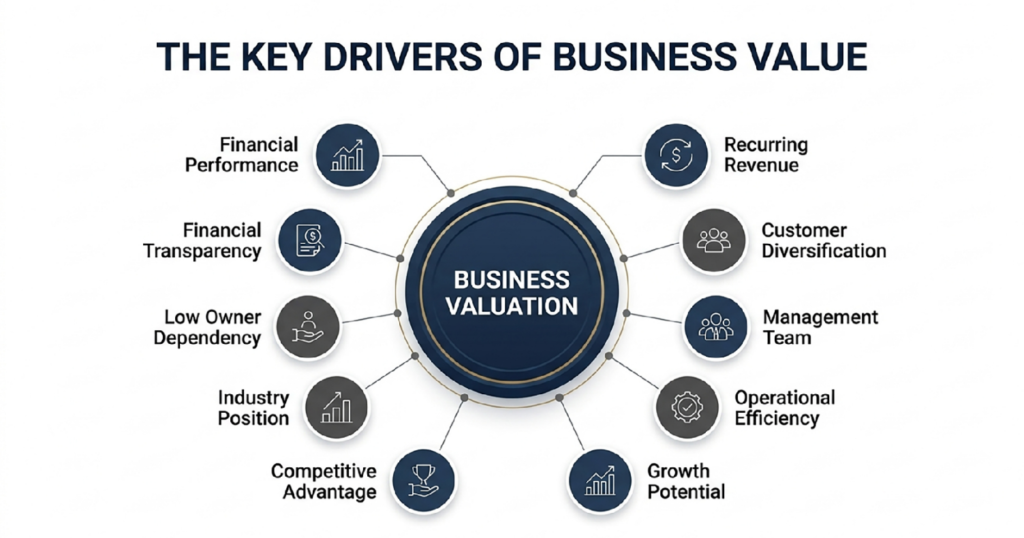
Every buyer wants the same outcome: acquiring a business that generates reliable earnings with manageable risk and strong growth potential.
While every transaction is unique, several characteristics consistently contribute to higher acquisition offers.
Below are the factors buyers repeatedly reward when evaluating businesses.
1. Strong and Consistent Financial Performance
Healthy financial performance remains the foundation of every business valuation.
Buyers want to see:
- Consistent revenue growth
- Stable EBITDA margins
- Positive cash flow
- Sustainable profitability
- Well-managed expenses
Businesses that demonstrate predictable financial results over multiple years inspire greater confidence than companies experiencing volatile performance.
Strong financial reporting also allows buyers to verify earnings quickly during due diligence, reducing uncertainty throughout the transaction process.
Buyer Perspective: Buyers rarely pay a premium for one outstanding year. They pay for businesses that consistently perform well over time.
2. Predictable and Recurring Revenue
Predictability is one of the most valuable assets a business can possess.
Companies with recurring revenue models provide buyers with greater confidence that future cash flow will remain stable after the acquisition.
Examples include:
- Subscription services
- Maintenance agreements
- Annual contracts
- Long-term customer relationships
- Recurring service revenue
Businesses relying heavily on one-time projects or unpredictable sales cycles often receive lower valuation multiples because future revenue is less certain.
Even businesses without subscription models can improve predictability by increasing customer retention and establishing long-term contracts.
3. Diversified Customer Base
Customer concentration is one of the most closely examined areas during due diligence.
Imagine two businesses with identical revenue and profitability.
- Business A generates 45% of its revenue from one customer.
- Business B’s largest customer contributes only 8% of annual revenue.
Although both companies appear equally profitable today, Business B presents significantly lower risk.
If Business A loses its largest customer after closing, the buyer’s investment could be substantially affected.
A diversified customer portfolio demonstrates stability and reduces dependency on any single relationship, making the business considerably more attractive.
4. An Experienced Management Team
A business should be capable of operating successfully without relying on the owner for every decision.
Buyers place significant value on organizations that have:
- Department managers
- Operational leadership
- Sales leadership
- Financial oversight
- Clear organizational responsibilities
When experienced managers are already running daily operations, buyers see a smoother ownership transition and reduced operational risk.
Businesses built around a single owner often receive discounted offers because continuity becomes uncertain after the sale.
5. Operational Efficiency and Scalability
Buyers don’t just evaluate today’s performance-they assess tomorrow’s opportunities.
Businesses with documented systems, standardized procedures, and efficient operations are easier to scale and integrate after acquisition.
Examples include:
- Standard operating procedures
- CRM systems
- ERP platforms
- Automated workflows
- Documented training programs
- Performance reporting systems
Scalable businesses can grow revenue without proportionally increasing operating costs, making them significantly more valuable.
6. Clean Financial Records and Transparency
Financial transparency builds buyer confidence.
Well-organized financial records demonstrate professionalism and reduce the likelihood of unexpected issues during due diligence.
Buyers expect access to:
- Profit and loss statements
- Balance sheets
- Cash flow statements
- Tax returns
- Customer reports
- Financial forecasts
- Supporting documentation
Incomplete or inconsistent financial records often result in additional due diligence, delayed closings, or reduced purchase offers.
7. Competitive Advantages
Businesses that stand apart from competitors typically command stronger valuations.
Competitive advantages may include:
- Proprietary technology
- Patents
- Exclusive supplier agreements
- Long-term customer contracts
- Strong brand reputation
- Specialized expertise
- High switching costs
These advantages make future earnings more sustainable and reduce competitive pressure, giving buyers greater confidence in long-term performance.
8. Industry Growth and Market Position
Even exceptional businesses operate within broader market conditions.
Companies positioned in industries experiencing sustained growth often receive stronger buyer interest than businesses operating in mature or declining markets.
Buyers consider factors such as:
- Market demand
- Industry trends
- Competitive landscape
- Regulatory environment
- Economic outlook
While industry conditions can’t be controlled, understanding your market position helps establish realistic valuation expectations.
9. Low Owner Dependency
One of the most common value killers is owner dependency.
If customers, employees, suppliers, and major decisions all rely on the owner, buyers inherit considerable transition risk.
Businesses become more valuable when:
- Key relationships are shared across the organization.
- Processes are documented.
- Leadership responsibilities are delegated.
- Customers trust the business-not just the owner.
Reducing owner dependency is often one of the highest-return initiatives for business owners planning an exit.
10. Preparation Before Going to Market
Businesses rarely achieve premium valuations by accident.
The strongest transactions are typically the result of thoughtful preparation that begins well before a business is officially listed for sale.
Preparing early allows owners to:
- Improve financial reporting
- Address operational weaknesses
- Resolve legal issues
- Strengthen management
- Organize due diligence documentation
- Improve profitability
- Reduce business risk
Waiting until a Letter of Intent has been signed often limits the ability to address issues that buyers uncover during due diligence.
What Can Reduce Your Business Valuation?
Understanding what increases value is only half the equation.
Business owners should also recognize the issues that frequently cause buyers to reduce acquisition offers.
| Value Drivers | Value Reducers |
| Recurring revenue | Heavy customer concentration |
| Consistent profitability | Declining financial performance |
| Diversified customer base | Owner dependency |
| Experienced management | Weak leadership structure |
| Clean financial records | Poor bookkeeping |
| Scalable operations | Inefficient processes |
| Competitive advantage | Intense competitive pressure |
| Early sale preparation | Poor due diligence readiness |
A common theme emerges across nearly every acquisition:
Businesses receive premium valuations when they reduce buyer uncertainty.
Every improvement that strengthens predictability, lowers operational risk, and demonstrates long-term sustainability increases buyer confidence-and confidence is what ultimately drives stronger acquisition offers.
How to Increase Your Business Valuation Before Selling
Improving your company’s value doesn’t happen overnight, but many of the most impactful changes can be implemented well before entering the market.
Consider prioritizing the following initiatives:
- Strengthen recurring revenue streams.
- Diversify your customer base.
- Build a capable management team.
- Improve financial reporting and bookkeeping.
- Document key business processes.
- Reduce owner dependency.
- Resolve legal and compliance issues.
- Prepare thoroughly for due diligence.
- Develop a clear growth strategy buyers can build upon.
These improvements not only increase the perceived quality of your business but also help create a more competitive sale process.
Key Takeaway: Buyers don’t pay premium prices simply because a business is larger-they pay more for businesses that are predictable, transferable, financially disciplined, and positioned for sustainable growth. Those are the characteristics that consistently drive higher business valuations.
Frequently Asked Questions
1. What factors have the biggest impact on a business valuation?
Several factors influence business value, but buyers typically place the greatest emphasis on consistent financial performance, EBITDA, recurring revenue, customer diversification, experienced management, operational efficiency, and future growth potential. Businesses that demonstrate predictable earnings and lower operational risk generally receive higher valuation multiples.
2. Does higher revenue automatically mean a higher business valuation?
No. Revenue is only one component of a valuation.
A business generating significant revenue but low profitability, high customer concentration, or heavy owner dependency may receive a lower valuation than a smaller company with stronger margins, recurring revenue, and scalable operations.
Ultimately, buyers focus on the quality and sustainability of earnings rather than revenue alone.
3. Why do similar businesses receive different acquisition offers?
Every buyer evaluates a company’s risk profile, growth opportunities, financial performance, and operational maturity.
Two businesses with similar revenue and EBITDA can receive very different offers if one has recurring revenue, diversified customers, experienced management, and clean financial records while the other does not.
4. How important is EBITDA in determining business value?
EBITDA is one of the most commonly used metrics in lower middle market acquisitions because it measures the company’s operating performance before financing and accounting decisions.
However, EBITDA alone doesn’t determine value. Buyers also evaluate the quality of those earnings, expected future growth, and the overall risk associated with the business.
5. How can I increase my business valuation before selling?
Some of the most effective ways include:
- Increasing recurring revenue
- Improving profitability
- Diversifying your customer base
- Building a strong management team
- Reducing owner dependency
- Maintaining accurate financial records
- Preparing early for due diligence
The earlier these improvements begin, the greater their impact on valuation.
6. When should I start preparing my business for sale?
Ideally, preparation should begin 12 to 36 months before going to market.
Early planning provides time to improve operations, strengthen financial performance, resolve potential issues, and position the business for a more competitive sale process.
7. Can an M&A advisor help increase my business value?
Yes. An experienced M&A advisor can identify value drivers, uncover potential risks, prepare your business for buyer scrutiny, position the company effectively in the market, and manage a competitive sale process.
Beyond facilitating the transaction, advisors help business owners maximize value before negotiations begin.
Conclusion
Business valuation isn’t determined by a single formula, nor is it based solely on revenue or EBITDA.
Buyers evaluate the complete picture-financial performance, operational strength, management capability, customer relationships, growth opportunities, and the level of risk they’ll inherit after the acquisition. Businesses that consistently perform well in these areas are often rewarded with stronger acquisition offers and more competitive valuation multiples.
The encouraging news is that many of these value drivers are within a business owner’s control. Improving financial reporting, reducing owner dependency, diversifying revenue, strengthening leadership, and preparing for due diligence can significantly enhance both buyer confidence and business value.
If you’re considering selling your business-whether in the near future or several years from now-understanding what drives higher valuations is one of the smartest investments you can make. The most successful exits are rarely the result of last-minute preparation; they’re built through deliberate planning and strategic improvements over time.
At Horizon M&A, we work with business owners to evaluate their company’s market readiness, identify opportunities to enhance value, and guide them through every stage of the sell-side M&A process. Whether you’re exploring your options or actively preparing for an exit, taking action early can help position your business for a stronger outcome when the right opportunity arises.