

What Business Owners Should Know About Buyers, Valuation and Exit Planning
California’s facility services industry is attracting buyers looking to expand their service capabilities, enter new markets and build larger operating platforms.
For owners of commercial cleaning, HVAC, building maintenance and other facility services companies, this creates potential opportunities. But an active acquisition market does not guarantee a successful sale.
Buyers are not just purchasing revenue. They are evaluating the quality of earnings, customer relationships, workforce and business operations they will inherit.
This report examines the latest market signals, real California transactions and the factors that can influence a facility services business sale.
1. Facility Services M&A Market: Key Findings
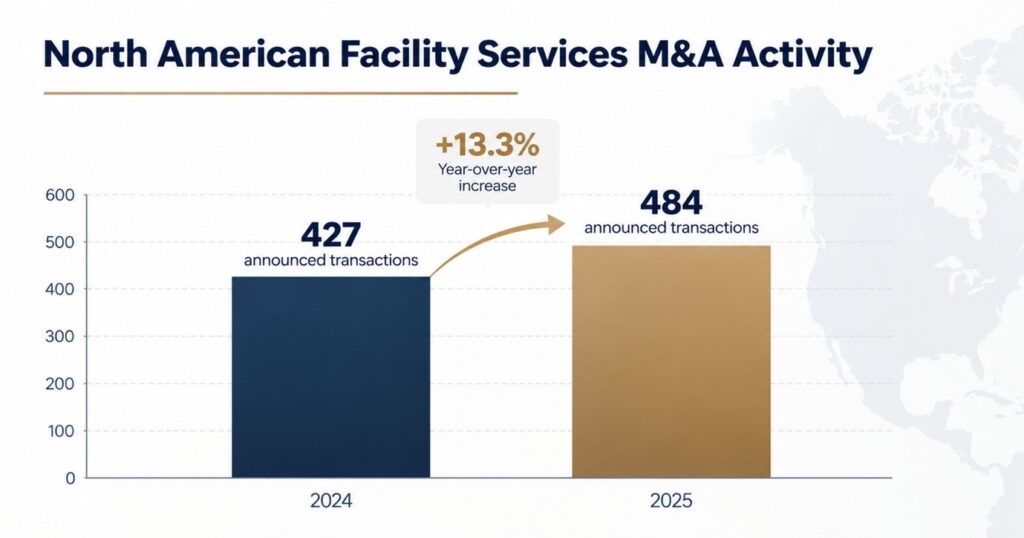
North American facility services M&A activity increased in 2025. Sequeira Partners reported 484 announced transactions in 2025, compared with 427 in 2024, an increase of approximately 13.3%.
These figures cover North America, not California alone. They indicate broader industry activity rather than the number of California businesses sold.
Three developments matter to business owners:
- Industry consolidation: Buyers can use acquisitions to expand their geographic reach and add customers or services.
- Interest in specialized services: Maintenance, testing, inspection and fire and life safety are among the categories highlighted in recent industry transaction reporting.
- Greater scrutiny of business quality: Buyers need evidence that earnings are sustainable, customer relationships are durable and operations can continue after a change in ownership.
The takeaway is straightforward: market activity may create opportunities, but a company’s financial and operational strength will influence its attractiveness to buyers.
2. Recent California Facility Services Transactions
Publicly announced transactions provide a more tangible picture of how buyers are expanding in California.
| Transaction | What happened | Why it matters |
| Uniserve Facilities Services, January 2026 | Acquired by Two Roads Partners. The California-based company provides commercial cleaning and other facility services. | Illustrates investor interest in established regional providers with multiple service offerings and long-standing customer relationships. |
| Buffalo’s Mechanical, February 2025 | Sold to Iron Mechanical. The company provides commercial HVAC services across Northern and Central California. | Demonstrates how an established technical service provider can become an acquisition opportunity for a larger operator seeking to expand its capabilities. |
| Spencer Building Maintenance, July 2024 | Acquired by Marsden Services. The Sacramento-based janitorial contractor had approximately 400 employees. | Shows how an established regional cleaning business can support a buyer’s geographic expansion. |
These transactions demonstrate activity across different facility services business models. They do not establish a typical sale price or valuation multiple for California businesses. Financial terms were not publicly disclosed for these transactions.
The lesson for owners: Buyers may pursue businesses for different reasons. A cleaning contractor may offer geographic coverage and customer relationships, while an HVAC company may provide technical capabilities and access to new customers.
The most relevant buyer is the one with a clear strategic or financial reason to acquire your particular business.

3. What Makes a Facility Services Business Attractive to Buyers?
Buyers evaluate each business individually, but several factors commonly influence their assessment.
Recurring customer relationships
Ongoing service agreements can make revenue more predictable. Buyers will examine renewal rates, cancellation rights, contract profitability and customer retention.
Consistent profitability
Revenue growth is valuable, but buyers also want to understand how much profit the business generates and whether that performance can continue.
A diversified customer base
Heavy dependence on a single customer can create risk. Buyers want to understand the impact of losing a major account.
A reliable workforce and management team
A company that depends entirely on its owner may be harder to transfer. Buyers want confidence that employees and managers can maintain service quality after the acquisition.
Clear operating and financial records
Reliable reporting helps buyers evaluate performance, investigate risks and complete due diligence more efficiently.
These factors do not guarantee a premium valuation. They help buyers understand what they are acquiring and how much uncertainty remains.
4. How Much Is a Facility Services Business Worth?
There is no universal valuation multiple for facility services companies.
One common measure is EBITDA, which stands for earnings before interest, taxes, depreciation and amortization. Buyers often use EBITDA to assess operating profitability and compare businesses.
A simplified valuation calculation is:
Enterprise Value = EBITDA × Valuation Multiple
For illustration, a business with $1 million in normalized annual EBITDA valued at a 5× multiple would have an implied enterprise value of $5 million.
This is an example, not a market benchmark or valuation estimate for a California business.
The actual valuation depends on factors such as:
- Business size and profitability.
- Recurring revenue and contract quality.
- Customer concentration and retention.
- Growth opportunities.
- Management depth and owner dependence.
- Relevant comparable transactions and buyer demand.
Enterprise value is also not the same as the amount the owner receives. Debt, cash, transaction expenses, working-capital adjustments and other deal terms can affect the final proceeds.
A credible valuation should be based on the company’s financial performance, relevant market evidence and the terms a buyer is prepared to offer.
5. What Can Reduce the Value or Delay a Sale?
Some of the most significant problems become visible only when a buyer begins investigating the business.
| Potential issue | Why buyers care | What owners can do |
| High customer concentration | Losing one major account could materially reduce earnings. | Review revenue by customer and strengthen the broader account base. |
| Unprofitable contracts | High revenue may conceal rising labour costs or weak margins. | Review profitability by customer, site or contract. |
| Inconsistent financial records | Buyers may struggle to verify reported earnings. | Reconcile financial statements and organize supporting documentation. |
| Owner dependence | The business may struggle to operate after the owner leaves. | Delegate responsibilities and strengthen management. |
| Compliance or contract issues | Unresolved obligations may create costs, delays or transaction risk. | Review material issues with qualified legal and compliance professionals. |
The goal is not to make a business appear perfect. It is to identify material risks early, address what can reasonably be addressed and present the remaining issues accurately.
6. How to Prepare Your Business for a Sale
Owners do not need to wait until they are ready to sell before preparing.
A practical starting point is to focus on five areas:
- Financial performance: Organize financial statements, tax returns and evidence supporting reported earnings.
- Customer contracts: Review renewal terms, cancellation rights, pricing and customer concentration.
- Operational performance: Understand profitability by customer or service line, workforce costs and service quality.
- Management readiness: Reduce reliance on the owner for daily decisions and critical customer relationships.
- Sale strategy: Identify suitable buyers and assess the terms, timing and transition requirements that fit your objectives.
Early preparation gives owners more time to strengthen the business and make informed decisions about when and how to sell.
7. Frequently Asked Questions
Are facility services businesses attracting buyers in 2026?
Published industry reports indicate that North American facility services transaction activity increased in 2025. California transactions also demonstrate continued acquisition activity. However, buyer interest varies by business type, size, profitability and strategic fit.
Which facility services companies may attract buyers?
Commercial cleaning, HVAC, building maintenance, fire and life safety, landscaping and other specialized service providers may attract interest. No single category guarantees a successful sale.
How long does it take to sell a facility services business?
The timeline depends on preparation, buyer interest, financial complexity, due diligence, negotiations and transaction approvals. Owners should establish a realistic timeline after reviewing their business and objectives.
Should I prepare my business before deciding to sell?
Yes. Reviewing financial records, contracts, customer concentration and management responsibilities can help owners identify weaknesses and understand their options before entering a formal sale process.
Conclusion: Prepare Before You Go to Market
The California facility services market offers potential opportunities for owners considering an exit. But market activity alone will not determine the value or outcome of an individual transaction.
Buyers need confidence in the company’s earnings, customer relationships, workforce and ability to operate under new ownership.
For business owners, the first step is understanding how a buyer may evaluate the company and identifying what needs attention before a sale process begins.
Considering selling your facility services business?
Horizon M&A Advisors can help you assess your exit options, understand potential buyer interest and develop a practical plan for a confidential sale process.