
What Horizon M&A Advisors is watching, what the market data says, and what it means for business owners

Introduction
Q3 2026 is not a market where every Northern California business is receiving the same valuation. The broader lower middle market is active, but buyers are increasingly selective about the quality of the companies they pursue. For owners, that distinction matters: strong businesses can still attract competition, while businesses with weak earnings quality, customer concentration or heavy owner dependency can face tougher underwriting.
At Horizon M&A Advisors, we look at the national deal data alongside what we see in the Northern California market. There is no credible public database that publishes a single ‘Northern California multiple’ for lower middle-market companies, so we will not manufacture one. Instead, this quarterly market view combines current national data with the regional sectors, buyer behavior and seller issues most relevant to Northern California owners.
Q3 2026 Market Snapshot
The market is best described as active but selective. The opportunity is still there, but quality matters more than simply being in the market.
| Market signal | What the current data shows | Seller implication |
| Deal activity | Axial reported 3,523 deals brought to market through its platform in Q2 2026, up 4.79% year over year and the highest quarterly total in its series. | There is meaningful deal supply, so standing out as a high-quality asset matters. |
| Buyer selectivity | Axial’s 2026 outlook found limited quality deal flow remained the top constraint on capital deployment, while buyers remained disciplined on valuation. | Quality businesses can attract attention, but weak businesses should not expect the market to overlook problems. |
| Buyer competition | 46.7% of surveyed Axial dealmakers identified buyer competition for quality assets as the strongest upward pressure on valuations. | Competitive processes can create leverage when the business is prepared and positioned correctly. |
| Deal structure | SRS Acquiom reports earnouts in 29% of LMM deals up to $50M and 35% of the smallest LMM deals up to $25M. | Headline valuation is only part of the outcome. Structure, certainty of payment and risk allocation matter. |
Source note: These figures are national/lower-middle-market indicators, not Northern California-specific statistics. They are used here to establish the broader market backdrop.
What the Q3 Market Is Telling Sellers

The lower middle market remains active, but buyers are becoming more selective about where they deploy capital. Deal activity is still meaningful, yet buyers are placing greater emphasis on earnings quality, risk and diligence.
For Northern California owners, the takeaway is simple: market activity creates opportunity, but business quality determines how much of that opportunity you can capture. Companies with durable earnings, strong management and clear strategic value are better positioned to attract competitive buyer interest.
The National Backdrop
Axial’s Q2 2026 data shows record quarterly deal volume on its platform, with 3,523 businesses brought to market, a 4.79% increase from Q2 2025. Industrials ranked first in both deal volume and buyer pursuit rate for the fourth consecutive quarter, while healthcare and transportation also showed strong relative buyer interest.
Axial’s 2026 lower middle-market outlook also points to a market that is stabilizing rather than returning to the easier underwriting environment of earlier cycles. Limited quality deal flow remained the leading constraint on capital deployment, and 46.7% of surveyed dealmakers identified buyer competition for quality assets as the strongest upward pressure on valuations.
Structure Is Doing More of the Work
Price is only one part of the transaction. SRS Acquiom’s 2026 lower-middle-market report, based on more than 4,400 private-target transactions that closed through 2025, found earnouts in 29% of lower middle-market deals up to $50 million and 35% of the smallest deals up to $25 million.
For sellers, that means a buyer’s headline offer should never be evaluated in isolation. Cash at close, earnouts, seller notes, rollover equity, working-capital adjustments, indemnification and other terms can materially change the economics and risk of a transaction.
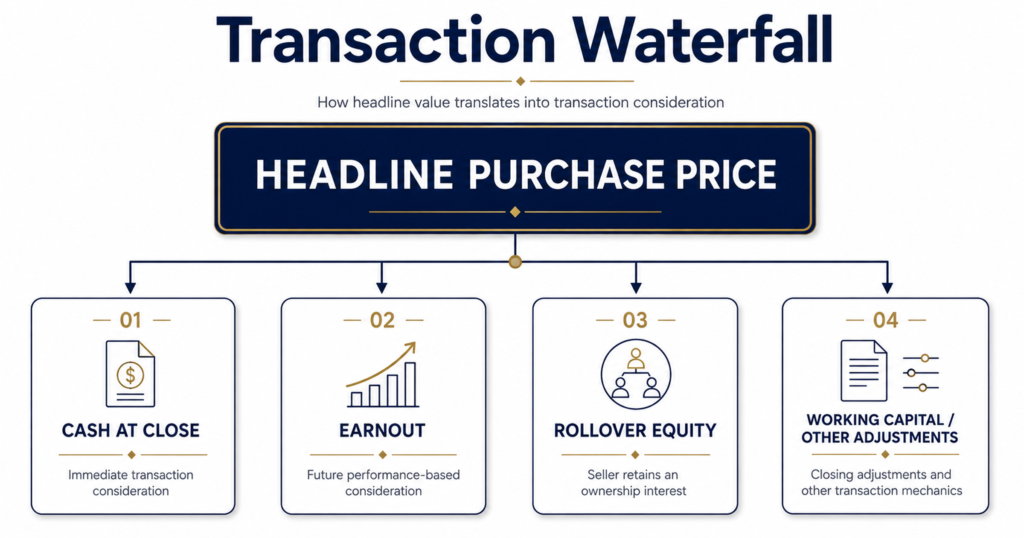
A buyer’s headline purchase price is only one part of the deal. The real value of an offer depends on how much you receive at closing, how much is contingent on future performance, what equity you retain, and what adjustments can change the final proceeds.
When comparing offers, look beyond the headline number. A slightly lower offer with more cash at close and fewer contingencies can sometimes be more attractive than a higher offer with significant earnout risk.
The highest headline valuation is not always the highest-quality outcome.
What We’re Actually Seeing in Northern California
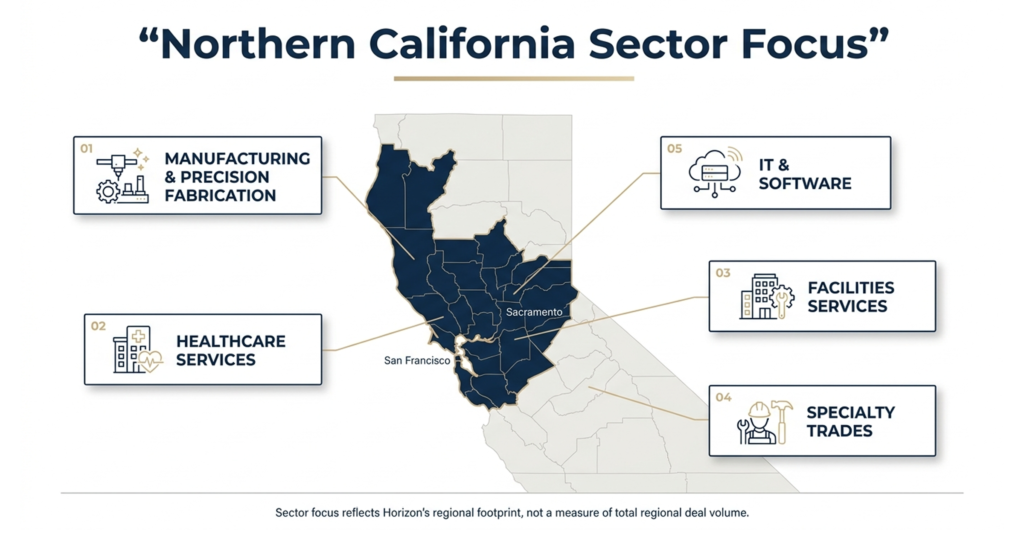
Horizon works across sectors that are important to the Northern California lower middle market, including manufacturing and precision metal fabrication, healthcare services, facilities services, specialty trade contractors, and IT/software businesses. The regional opportunity is real, but the factors shaping individual transactions are more specific than geography alone.
Labor and real estate costs matter
Buyers evaluating a Northern California operating company will underwrite labor costs, facility costs and margin durability. Geography does not automatically dictate a discount, but a business needs to demonstrate pricing power, operational discipline and sustainable margins.
Technology and IT-adjacent businesses remain strategically relevant
Northern California’s technology ecosystem creates a deep pool of strategic and financial buyers for technology, IT services and technical-service businesses. The strongest targets can benefit from recurring revenue, specialized capabilities and scalable delivery models.
Manufacturing and specialty trades have succession-driven supply
Owner succession continues to create opportunities for buyers seeking established manufacturing, fabrication and specialty-trade businesses. For sellers, the key question is whether the business can transition successfully without the founder.
Healthcare services continue to attract platform interest
Healthcare remains an active consolidation theme nationally. Northern California businesses with durable demand, strong compliance, management depth and attractive customer economics can fit regional and national buyer strategies.
The Multiple Is Not Automatically a Geography Discount
One of the easiest mistakes for a Northern California owner is to assume the location itself determines the multiple. It does not. Buyers primarily underwrite earnings quality, growth, concentration risk, management depth, recurring revenue and the durability of cash flow.
Geography does, however, influence the buyer universe, operating costs, competitive landscape and strategic fit. A business located in Northern California may be especially attractive to a buyer seeking geographic expansion, technical talent, customer density or a strategic foothold in the region.
The multiple isn’t automatically discounted for geography. The underwriting still has to prove the earnings.
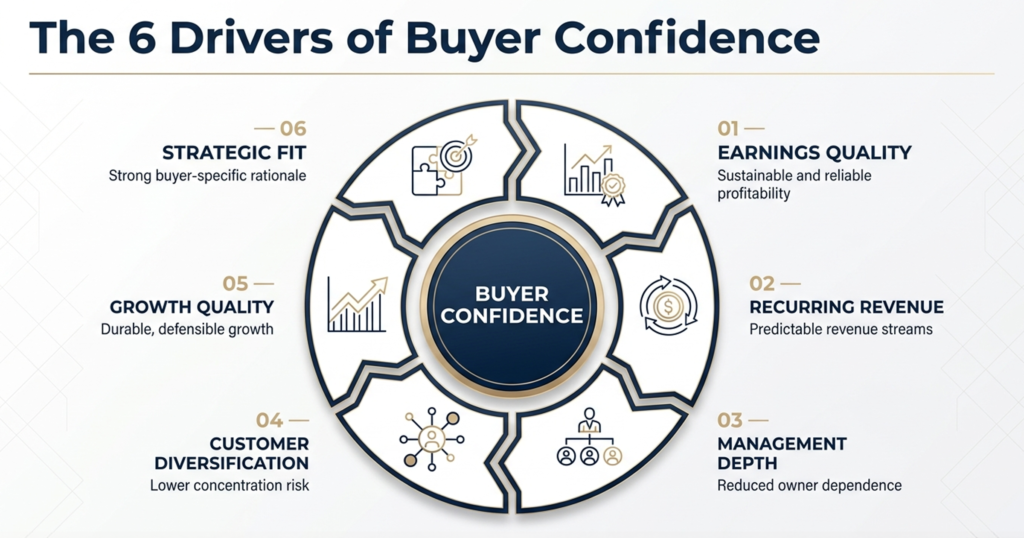
What Buyers Are Paying For in 2026
Durable earnings: Can the buyer trust the reported EBITDA after normalization?
Recurring revenue: How much revenue is contracted, repeatable or highly predictable?
Management depth: Can the company perform without the founder?
Customer diversification: What happens if the largest customer leaves?
Growth quality: Is growth profitable, repeatable and supported by the operating model?
Strategic fit: Does the company create geographic, customer, service or capability synergies for a buyer?
What This Means If You’re Considering a Sale
The current market favors sellers who are prepared. Buyers have more information, more disciplined underwriting processes and more ways to structure risk than they did in easier deal environments.
- Clean financials with defensible add-backs.
- A documented explanation of historical and projected growth.
- Limited dependence on the owner for sales, operations and key relationships.
- Clear visibility into recurring and repeat revenue.
- Customer concentration that can be explained and managed.
- An experienced management team or credible transition plan.
- A realistic understanding of valuation and the buyer universe.
If you are considering a transaction in the next 12 to 24 months, the most useful exercise is not watching the headline multiple. It is understanding where your specific business stands against the factors buyers are underwriting today.
Five Questions to Ask About Your Own Business
- Would the business produce the same earnings if I stepped away for 90 days?
- Can I prove that the revenue base is durable and repeatable?
- Could one customer loss materially change the investment case?
- Would a buyer agree with every major add-back in my adjusted EBITDA?
- Which buyer types would have the strongest strategic reason to acquire this business?
How Horizon M&A Can Help
If you’re considering a sale, recapitalization, or strategic transition, the question isn’t simply where the market is trading. It’s where your business fits within today’s market, what it could be worth, and which buyers are most likely to see its value.
Horizon M&A Advisors provides a confidential assessment of your business valuation, buyer profile, and exit readiness, helping you make an informed decision before going to market.
Get My Confidential Market Assessment →
Not ready to discuss a transaction yet?
Take the Exit Readiness Assessment →
FAQ
Are business valuations higher in the Bay Area than the rest of the country?
Not automatically. There is no credible public source that publishes a single Bay Area lower-middle-market multiple. Buyers primarily price the business on earnings quality, growth, risk and strategic fit. Geography can influence the buyer universe and strategic rationale, but it is not a standalone valuation formula.
What size businesses are attracting buyer interest in the lower middle market?
Axial’s 2026 buyer data indicates meaningful buyer interest across businesses from sub-$1M EBITDA through scaled $10M+ EBITDA platforms, with strong buyer appetite around the $1M–$5M EBITDA range. The appropriate buyer universe depends on sector, growth, geography and business quality.
Is Q3 a good time to start a sale process?
Q3 can be a sensible time to begin preparation, particularly if the goal is a transaction over the following several quarters. But market timing should not substitute for business readiness. A poorly prepared company can lose more value in diligence and negotiation than it gains from entering the market at a favorable point in the cycle.
How do higher financing costs affect lower middle market valuations?
Higher financing costs can reduce leverage capacity and therefore affect what some buyers can pay. Strategic buyers and well-capitalized sponsors can have different financing sensitivity. This is another reason sellers should evaluate the full buyer universe and transaction structure rather than relying on one market multiple.