
And what separates the deals that actually make it to closing

Introduction
Signing a Letter of Intent can feel like the hardest part of selling a business. In reality, it is the point where the transaction moves into a much more consequential phase: exclusivity, diligence, financing, documentation and closing.
Available lower middle market research suggests that a meaningful minority of signed LOIs fail to reach closing. The exact percentage varies by transaction type, financing structure and source methodology, so this article uses the more defensible framing of roughly one in three rather than presenting an unsupported universal failure rate.
The important question is not simply why deals fail. It is which failures can be prevented before the LOI is signed, and what separates a transaction that survives diligence from one that gets re-traded, delayed or abandoned.
The Short Answer
Most post-LOI failures are not caused by one dramatic event. They are usually the result of problems that were not identified, documented or resolved early enough: weak financial support, customer concentration, unsupported add-backs, operational dependencies, financing issues, contract restrictions or misaligned expectations.
The strongest sellers treat the LOI as a milestone, not a finish line. The preparation that protects the transaction happens before exclusivity begins.
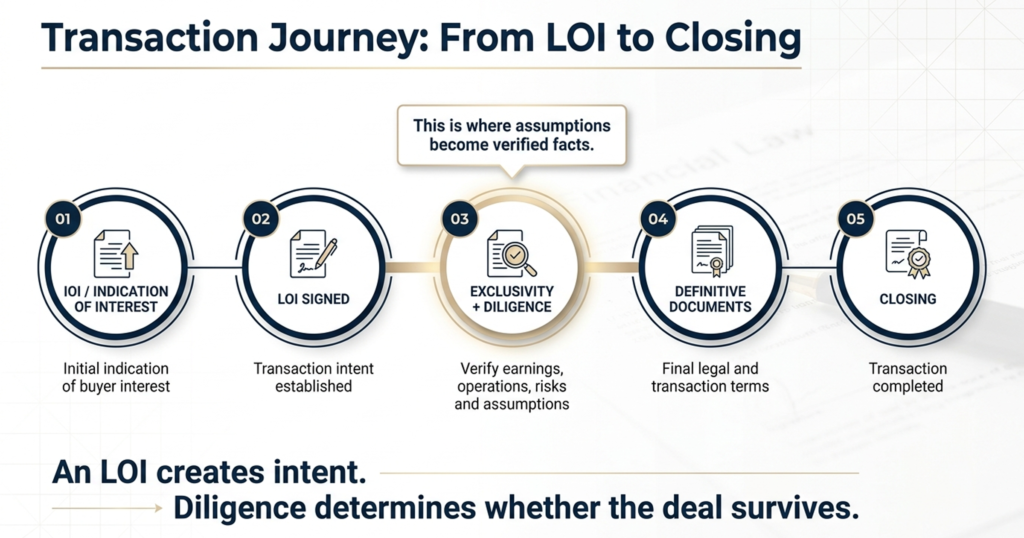
What an LOI Actually Is (and Isn’t)
An LOI is generally a preliminary document outlining proposed economics and key terms such as purchase price, structure, financing assumptions, working capital, earnouts, rollover equity, exclusivity, confidentiality and timing.
Much of the economic language is typically non-binding, while provisions such as confidentiality and exclusivity may be binding. The exact legal effect depends on the document and governing law, so sellers should have transaction counsel review the language before signing.
Exclusivity is particularly important. Once a seller agrees not to pursue other buyers, competitive leverage can weaken while the buyer gains access to deeper information through diligence.
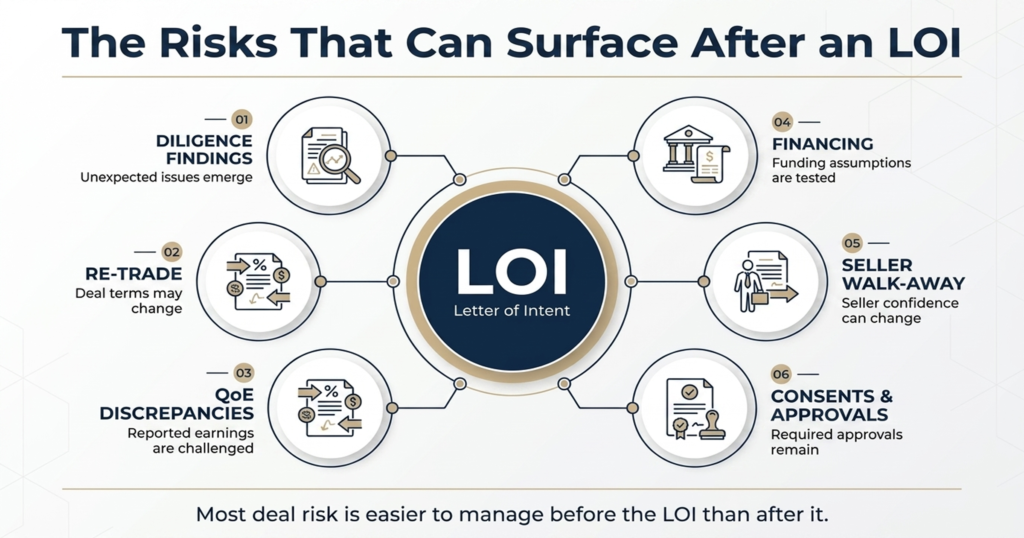
The Recurring Reasons Deals Die After LOI
1. Diligence findings the seller didn’t see coming
Financial, customer or operational diligence can uncover a concentration issue, revenue inconsistency, unresolved legal matter, weak contract or key-person dependency that was not fully understood before the LOI.
2. The re-trade
A buyer may return after diligence with a lower price or less favorable terms. This is harder to resist when there is no credible alternative buyer and the seller is deep into exclusivity.
3. Quality of Earnings discrepancies
Add-backs that appeared reasonable internally may not survive an independent Quality of Earnings review. When normalized EBITDA falls, the economic impact can be significant because the adjustment is multiplied by the transaction multiple.
4. Financing or material business change
Buyer financing may not come together as expected, or the business may experience a material event between LOI and closing, such as a major customer loss or key employee departure.
5. Seller walk-away after a re-trade
Sometimes the buyer does not walk. The seller does, when a major change in price or terms falls below an acceptable outcome.
6. Regulatory, contract or third-party consent issues
Lease assignments, customer contracts, licenses, permits or other approvals can create unexpected obstacles if they are not identified early.
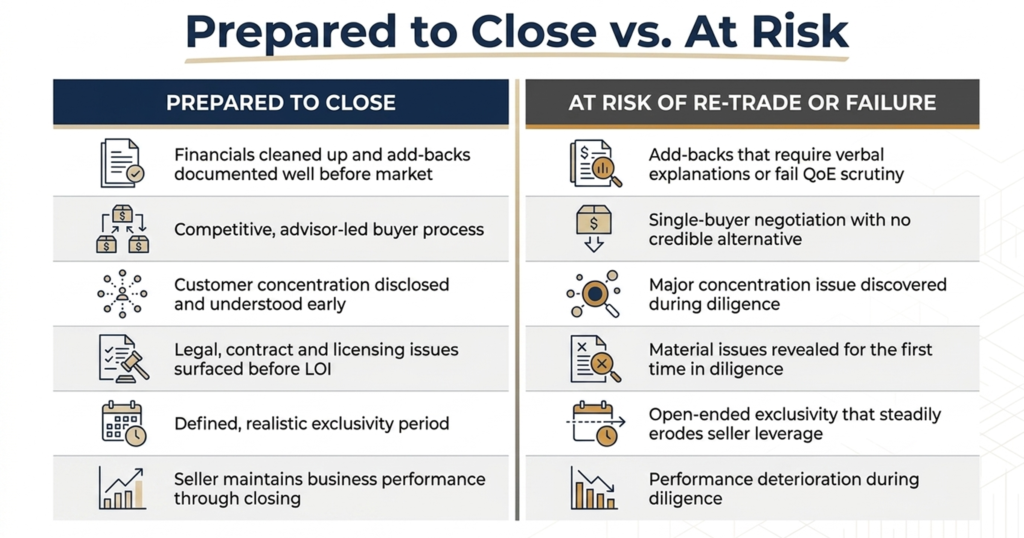
What Separates the Deals That Close
The strongest pattern is simple: preparation happens before the LOI, while weak preparation is exposed after it. The goal is not to eliminate every issue. It is to identify material issues early, document the economics, align expectations and preserve enough leverage to solve problems.
Why This Matters More Than the Headline Price
Owners naturally focus on the number in the LOI. But a higher headline price is not automatically a better outcome if it comes with greater closing risk, aggressive earnout conditions, uncertain financing or a buyer with a history of re-trading.
A slightly lower offer from a well-qualified buyer with stronger certainty of funds, clearer terms and a realistic path to closing can have greater expected value than a higher headline offer that is likely to deteriorate during diligence.
The objective is not simply to get an LOI signed. It is to get an LOI that survives diligence and turns into a closing.
How to Reduce Post-LOI Deal Risk
- Prepare and normalize financials before approaching buyers.
- Document every material add-back and support it.
- Identify customer concentration, key-person dependency and contract risks early.
- Understand the buyer’s financing plan before accepting an LOI.
- Negotiate an appropriate exclusivity period and clear diligence expectations.
- Maintain operating performance throughout the transaction.
- Run a competitive process where appropriate so you retain leverage if terms change.
How Horizon M&A Can Help
Once an LOI is signed, the transaction enters its most critical phase. Exclusivity, due diligence, financing and negotiations can all affect whether the deal ultimately closes on the terms you agreed to.
Horizon M&A Advisors helps business owners navigate this stage with a focus on protecting deal value, anticipating buyer concerns and keeping the transaction moving toward closing.
Already Have an LOI?
Before you enter or move deeper into diligence, get an experienced second opinion on the deal, its terms and the risks that could affect your outcome.
Not ready to discuss your LOI yet?
FAQ
What percentage of LOIs actually close in lower middle market M&A?
There is no authoritative registry covering every private LOI. Available deal-data commentary suggests that a meaningful minority of signed LOIs fail to reach closing, often described directionally as roughly one in three. Treat that figure as an estimate rather than a universal statistic.
What’s the most common reason an M&A deal falls apart after the LOI?
Diligence findings are a major source of post-LOI problems. Financial discrepancies, customer concentration, operational issues, legal matters and unsupported adjustments can lead to a re-trade or a failed transaction.
What is a re-trade in M&A?
A re-trade occurs when a buyer seeks to change the agreed economics or other terms after the LOI, often following diligence. The seller’s ability to resist depends on preparation, deal structure, buyer quality and whether other qualified buyers remain available.
How long does exclusivity typically last after an LOI?
The period varies by transaction. Lower middle market deals often use a defined diligence and exclusivity window, but the appropriate length depends on complexity, financing, regulatory requirements and documentation.
Can I prevent a re-trade?
No seller can eliminate all re-trade risk, but preparation can reduce it. Clean financials, defensible add-backs, proactive disclosure, early issue resolution and a competitive process can improve negotiating position.
Should I sign an LOI before completing all diligence on my own business?
A seller should understand the material risks of the business before signing. That does not mean completing the buyer’s full diligence process, but material financial, legal, customer and operational issues should be identified early.