
What drives MSP valuation, who is buying, and how deal terms affect what sellers actually receive

Introduction
MSP owners tend to enter a sale conversation with a stronger understanding of recurring revenue and operating metrics than many other business owners. They already think about MRR, churn, retention and service delivery because those metrics determine how they run the company.
But buyers evaluate an MSP through a different lens. They are underwriting the durability of recurring revenue, customer retention, delivery infrastructure, management depth, security capabilities and the likelihood that EBITDA will continue after the founder transitions out.
That is why two MSPs with similar revenue can receive very different offers. The multiple is only the starting point. The quality of recurring revenue and the risk a buyer believes it is taking often determine where the business lands within the market range.
What MSPs Are Actually Selling For
MSP valuations can vary substantially. The ranges below are an illustrative market framework, not a universal 2026 transaction database. Actual multiples vary by EBITDA, recurring revenue quality, customer concentration, growth, management depth, geography, buyer type and transaction structure.
| MSP Profile | Illustrative EBITDA Range | Revenue Multiple Context | What Drives the Range |
| Break-fix heavy / lower recurring revenue | 4x–6x | ~0.8x–1.5x | Lower recurring revenue, owner dependency, less predictable cash flow |
| Established MSP / 60–70% recurring | 6x–9x | ~1.3x–2.0x | Recurring revenue, retention, management and documented delivery |
| Strong MSP / 70%+ recurring | 9x–12x | ~2.0x–3.0x | High-quality MRR, low concentration, scalable operations and growth |
| Cybersecurity-led MSP / MSSP | Potentially above generalist ranges | Transaction-specific | Security revenue quality, specialization, retention and strategic fit |
Why Recurring Revenue Quality Matters
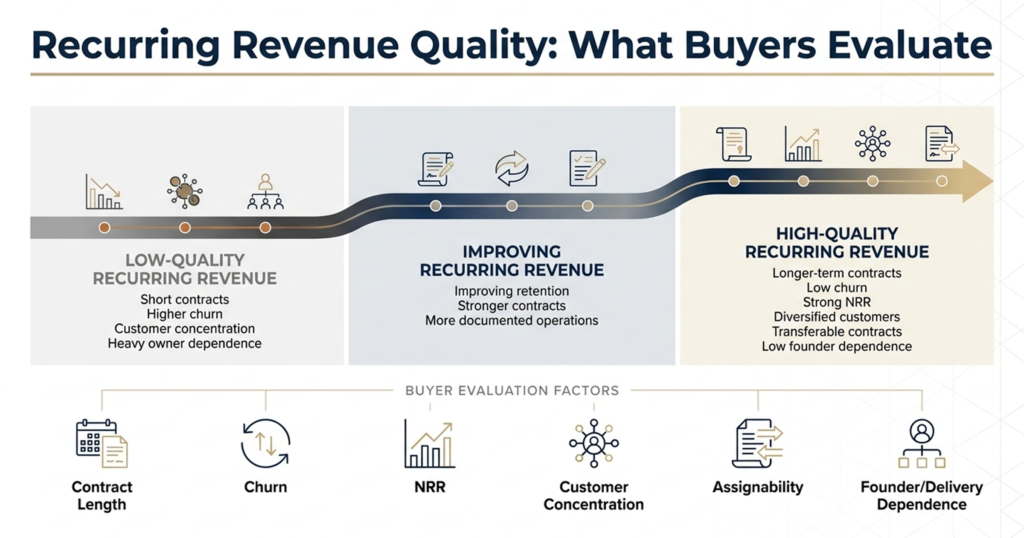
Across MSP transactions, one of the clearest valuation patterns is the relationship between recurring revenue quality and buyer confidence. A high percentage of MRR is useful, but buyers want to know how durable that MRR actually is.
Net revenue retention: Are existing clients expanding, staying flat, or shrinking?
Contract terms and assignability: Are agreements multi-year and transferable, or month-to-month?
Customer concentration: Does one customer represent a material share of MRR?
Delivery documentation: Can the buyer see repeatable service processes through the PSA/RMM stack and operating playbooks?
Churn history: Can the seller demonstrate consistent customer retention with historical data?
An MSP can report a high MRR percentage and still receive a lower multiple if that recurring revenue is fragile. Short contracts, high churn, customer concentration and founder-dependent delivery can all reduce buyer confidence.
The Security Premium: What Actually Matters
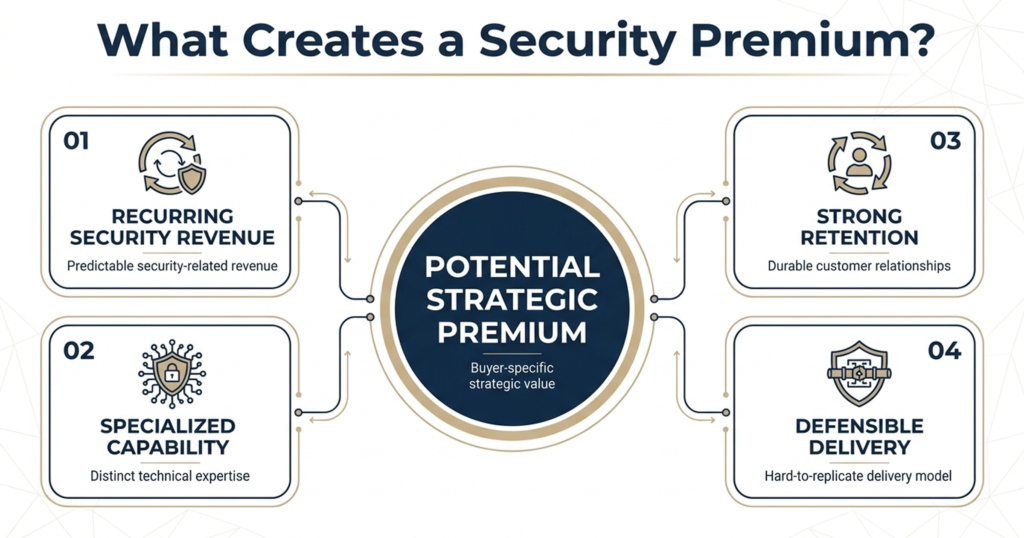
Cybersecurity capability can support a premium when it represents a real, differentiated and recurring part of the MSP’s economics. Buyers are not paying more simply because an MSP resells a security product. They are evaluating security services that can improve pricing, retention, customer stickiness, compliance capability and strategic differentiation.
For an MSP more than 12 months from a potential sale, the question is whether security investment can create durable enterprise value, not simply revenue. The strongest case involves recurring security revenue, credible delivery talent, documented processes and customers that value the capability.
Who’s Actually Buying MSPs?
The MSP buyer universe is broad. The right buyer depends on business size, recurring revenue, management depth, geography, service mix and the owner’s goals.
PE-backed national and regional consolidators
Seek platform fit and add-on opportunities, with emphasis on recurring revenue, scalable delivery and management depth.
Strategic acquirers
Larger MSPs, telecom providers, cloud providers and adjacent technology companies may acquire for geographic expansion, capability or customer access.
Search funds and individual buyers
Often relevant for smaller MSPs where owner transition, cash flow and financing capacity are central.
Because the buyer universe can be deep, an advisor-run competitive process can help identify buyers with the strongest strategic rationale rather than simply accepting the first credible offer.
How MSP Deals Actually Get Structured
The headline multiple is not the same as the seller’s final economics. Deal structure determines how much is received at closing, how much depends on future performance, and how much risk or upside the seller retains.
| Component | Typical Treatment | Why It Matters |
| Cash at close | Negotiated; usually the largest component | Immediate, certain liquidity |
| Earnout / contingent value | Negotiated based on risk and performance | Future payment depends on agreed conditions |
| Seller note | Negotiated financing component | Creates future payment and credit risk |
| Rollover equity | Common in some PE deals | Retains upside and future exposure |
| Working capital / adjustments | Defined in transaction documents | Can increase or reduce final proceeds |
A $6M headline offer with significant earnout and rollover is a different economic outcome from a $5.5M offer with substantially more cash at closing. Compare certainty, timing, risk and upside, not just the headline number.
Preparing an MSP to Maximize Value
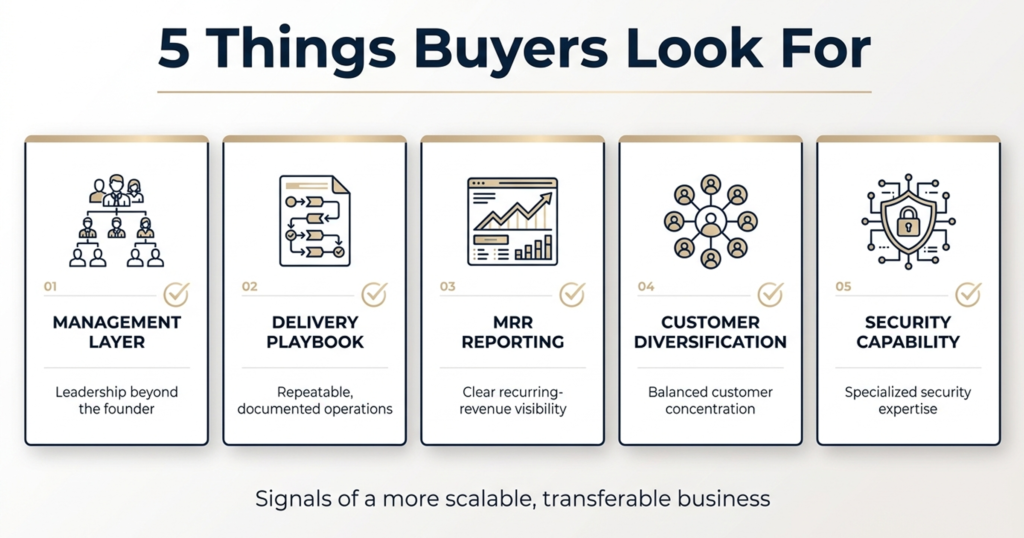
Build a management layer: Client relationships and service delivery should not depend entirely on the founder.
Document the delivery playbook: Show PSA/RMM maturity, ticket handling, SLA performance and repeatable processes.
Clean up MRR reporting: Track recurring revenue, churn and NRR with defensible historical data.
Address customer concentration: Understand and proactively manage material customer dependencies.
Strengthen security capability where appropriate: Invest where the capability can create durable recurring revenue, differentiation or retention.
What Buyers Will Examine Before Closing
- Historical and normalized EBITDA: Buyers verify the quality and sustainability of your reported earnings.
- MRR composition and retention: They assess how much revenue is truly recurring and how consistently customers stay.
- Customer concentration: Heavy dependence on a few customers can increase perceived risk.
- Contract terms and assignability: Buyers want confidence that key customer contracts can continue after the acquisition.
- Churn and net revenue retention: These metrics show whether the recurring revenue base is stable, growing, or shrinking.
- PSA/RMM and service-delivery processes: Buyers assess whether operations are documented, scalable, and transferable.
- Management and engineer depth: They want to know whether the business can operate successfully without the owner.
- Security and compliance capabilities: Strong security processes can improve customer retention and strategic value.
- Growth trajectory and pipeline quality: Buyers evaluate whether future growth is realistic, repeatable, and supported by a credible pipeline.
FAQ
What is my MSP worth if I have $1.5M in EBITDA and 70% recurring revenue?
An illustrative market framework could place a business with that profile within a mid-to-upper single-digit EBITDA range, but the appropriate multiple depends on retention, concentration, management, growth, contract quality and buyer fit. A formal valuation is needed to narrow the range.
Do private equity buyers pay more for MSPs than strategic buyers?
Not automatically. PE-backed consolidators can compete strongly for platform-fit businesses, while strategic buyers may pay a premium when a target fills a specific geographic, customer or capability gap. The best buyer depends on the seller’s objectives as well as price.
How much of an MSP sale is typically cash at closing?
There is no universal percentage. Deal structure varies by size, buyer, financing and risk allocation. Sellers should evaluate the complete consideration package rather than rely on a generic cash-at-close percentage.
Does cybersecurity capability increase MSP valuation?
It can, when security represents genuine recurring revenue, differentiated capability, strong retention and scalable delivery. Simply reselling a security product is not enough to justify a premium.
How long does it take to sell an MSP business?
A lower middle market MSP transaction can take several months from preparation through closing. Timing varies with financial readiness, buyer process, diligence, financing and complexity.
Should I use a revenue multiple to value my MSP?
Revenue multiples can be a useful cross-check, especially early in the process, but EBITDA and recurring-revenue quality usually provide more useful transaction context for a profitable lower middle market MSP.
How Horizon M&A Can Help
MSP valuation is not just about applying an industry multiple to EBITDA. The more important question is how a buyer will underwrite the durability of your recurring revenue, the strength of your delivery platform, the depth of your management team and the risks that remain after closing.
Get a confidential assessment of your MSP’s valuation range, buyer profile and transaction strategy before you go to market.