

Introduction
If you asked ten business owners, “How much is your business worth?” most would provide a rough estimate-or simply say they aren’t sure. Ironically, while many people know the value of their home, retirement account, or investment portfolio, they often have little understanding of the value of the largest asset they’ve spent decades building.
Knowing your company’s value isn’t only important when you’re ready to sell. A professional business valuation can help you make better strategic decisions, negotiate from a position of strength, attract investors, prepare for succession, or identify opportunities to increase enterprise value long before a transaction takes place.
In today’s market, buyers are more sophisticated than ever. They don’t purchase businesses based on revenue alone. They evaluate profitability, recurring cash flow, operational risks, growth potential, management depth, and dozens of other factors that determine whether a company deserves a premium valuation.
In this comprehensive guide, you’ll learn:
- What business valuation actually means
- When you should obtain a valuation
- The factors that influence business value
- The most common business valuation methods
- How buyers determine what they’re willing to pay
- Practical strategies to maximize your company’s value before selling
Whether you’re planning to exit next year or ten years from now, understanding how buyers think is one of the smartest investments you can make.
What Is Business Valuation?
Business valuation is the process of determining the economic value of a company using financial analysis, market data, industry benchmarks, and future earnings potential.
Simply put, it’s an objective assessment of what your business is worth in today’s market.
A professional valuation goes far beyond multiplying revenue by a standard percentage. Experienced valuation professionals examine:
- Historical financial performance
- EBITDA and cash flow
- Industry outlook
- Competitive position
- Customer relationships
- Growth opportunities
- Operational risks
- Market transaction data
The goal is to estimate what an informed buyer would reasonably pay under current market conditions.
Value vs. Price: Understanding the Difference
Many business owners assume that value and price are the same-but they are not.
Value is an estimate based on financial fundamentals, risk, and future earning potential.
Price is the amount ultimately agreed upon by a buyer and seller during negotiations.
For example, a business may have an estimated value of $12 million based on its financial performance. However, strategic buyers competing for the acquisition may drive the final purchase price significantly higher. Conversely, if the owner needs to sell quickly or the company has unresolved risks, the sale price could fall below its estimated value.
Understanding this distinction helps business owners set realistic expectations and negotiate more effectively.
When Should You Get a Business Valuation?
One of the biggest misconceptions among business owners is that valuation only matters when they’re preparing to sell. In reality, valuation is a strategic planning tool that provides valuable insights throughout the life of a business.
Here are some of the most common situations where a professional valuation becomes essential.
Preparing to Sell Your Business
Understanding your company’s value before entering the market allows you to identify weaknesses, improve key value drivers, and negotiate with confidence.
Exit Planning
The most successful exits are planned years-not months-in advance. Knowing your current value helps establish a roadmap for increasing enterprise value before an eventual sale.
Succession Planning
Whether transferring ownership to family members, employees, or management, an objective valuation helps ensure fairness and supports informed decision-making.
Raising Capital
Banks, private equity firms, and investors often evaluate company value before providing financing or making an investment.
Mergers and Acquisitions
A valuation helps buyers and sellers determine whether a proposed transaction is financially reasonable and supports effective negotiations.
Partner Buyouts
When one owner exits the business, an independent valuation provides a fair basis for determining ownership value and reducing disputes.
Divorce or Legal Proceedings
Business valuation is frequently required during legal disputes where ownership interests must be divided objectively.
Estate and Tax Planning
Accurate valuations help business owners plan wealth transfers, minimize tax exposure, and comply with regulatory requirements.
Annual Business Health Check
Even if you have no immediate plans to sell, obtaining a valuation every one to three years helps track progress, measure value creation, and identify opportunities for improvement.
Expert Tip: Waiting until you’re ready to sell often limits your ability to improve valuation. Buyers pay for businesses that have already addressed operational weaknesses-not businesses that promise future improvements.
The Main Factors That Influence Business Value
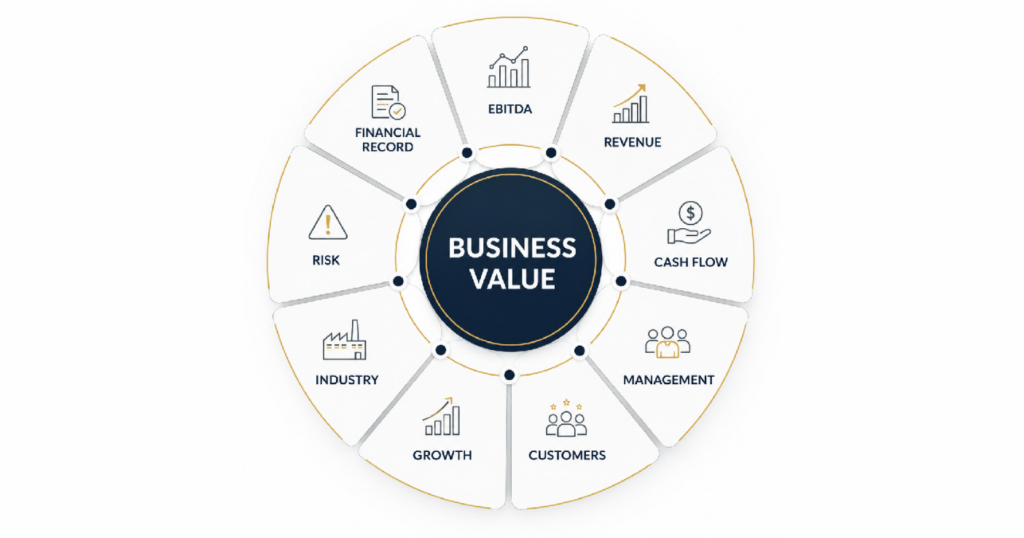
Every business is unique, but buyers consistently evaluate a core set of value drivers when determining what they’re willing to pay. Improving these areas can significantly increase both valuation multiples and buyer interest.
Revenue Growth
Consistent, predictable revenue growth demonstrates market demand and reduces perceived risk. Businesses with steady year-over-year growth typically command stronger valuations than companies with flat or declining sales.
EBITDA & Profitability
Revenue alone doesn’t determine value-profitability does.
EBITDA (Earnings Before Interest, Taxes, Depreciation, and Amortization) is one of the most widely used measures in lower middle market acquisitions because it reflects the company’s core operating performance.
Higher EBITDA margins generally translate into higher valuation multiples.
Cash Flow
Buyers acquire future cash flow, not historical revenue. Strong, reliable cash generation increases confidence that the business will continue producing returns after the acquisition.
Industry Trends
Growing industries often attract more buyers and command premium valuations, while businesses operating in declining markets may receive lower offers despite solid financial performance.
Customer Concentration
Heavy dependence on one or two major customers creates significant risk.
A diversified customer base makes future revenue more predictable and typically improves valuation.
Recurring Revenue
Subscription revenue, long-term contracts, maintenance agreements, and repeat customers reduce uncertainty and increase buyer confidence.
Recurring revenue is one of the strongest drivers of premium valuations.
Management Team
Businesses that operate successfully without the owner’s constant involvement are significantly more attractive to buyers.
An experienced management team reduces transition risk and improves scalability.
Owner Dependency
If the business relies heavily on the owner’s personal relationships, technical expertise, or daily decision-making, buyers often reduce their valuation to account for this additional risk.
Competitive Advantage
Unique intellectual property, proprietary processes, established brands, specialized expertise, or high barriers to entry strengthen long-term competitive positioning.
Businesses with clear competitive advantages typically receive higher offers.
Financial Reporting Quality
Accurate financial statements inspire confidence during due diligence.
Incomplete bookkeeping, inconsistent reporting, or unexplained financial adjustments can quickly reduce buyer confidence and delay transactions.
Growth Opportunities
Buyers don’t just purchase today’s earnings-they invest in tomorrow’s potential.
Businesses with identifiable expansion opportunities often justify higher valuation multiples.
Business Risks
Pending litigation, customer disputes, cybersecurity concerns, regulatory issues, supplier concentration, or operational inefficiencies can all negatively impact valuation.
Common Mistake: Many owners focus exclusively on increasing revenue while ignoring the operational risks buyers identify during due diligence. Improving business quality often creates more value than simply increasing sales.
Common Business Valuation Methods
No single valuation method works for every business. The right approach depends on your industry, company size, profitability, growth prospects, asset base, and the purpose of the valuation.
Professional valuation advisors often use multiple methods and compare the results to arrive at a well-supported valuation range rather than relying on a single calculation.
Below are the five most common business valuation methods used in the lower middle market.
1. EBITDA Multiple Valuation
The EBITDA Multiple method is the most widely used valuation approach for profitable businesses generating consistent earnings.
Rather than valuing a company based solely on revenue, buyers focus on how much cash the business generates from its core operations.
The basic formula is:
Business Value = Normalized EBITDA × EBITDA Multiple
The valuation multiple depends on several factors, including:
- Industry
- Business size
- Growth rate
- Customer diversification
- Recurring revenue
- Management strength
- Operational risk
- Market demand
Example
Suppose a manufacturing company generates:
- Revenue: $12 million
- Normalized EBITDA: $2 million
- Market EBITDA Multiple: 6×
Estimated Enterprise Value:
2,000,000 × 6 =12,000,000
If the company demonstrates exceptional growth, recurring revenue, and low customer concentration, buyers may be willing to pay a higher multiple.
2. Revenue Multiple Valuation
Revenue multiples are commonly used for businesses where profitability is still developing, such as:
- SaaS companies
- Technology startups
- Healthcare practices
- Fast-growing businesses
Instead of EBITDA, buyers apply a multiple to annual revenue.
For example:
Annual Revenue: $8 million
Revenue Multiple: 1.8×
Estimated Value:
$14.4 million
However, revenue multiples should never be viewed in isolation. Two businesses with identical revenue can have vastly different values depending on profitability, customer retention, and operating efficiency.
3. Discounted Cash Flow (DCF)
The Discounted Cash Flow (DCF) method estimates value based on the future cash flow a business is expected to generate.
Future earnings are projected over several years and then discounted back to today’s dollars using a discount rate that reflects investment risk.
DCF is particularly useful for:
- High-growth companies
- Businesses with predictable long-term cash flow
- Large acquisitions
- Strategic investment decisions
Advantages
- Forward-looking
- Considers future growth
- Highly analytical
Limitations
- Sensitive to assumptions
- Complex to prepare
- Small forecasting errors can significantly impact valuation
4. Asset-Based Valuation
This approach calculates value by determining the fair market value of business assets minus liabilities.
It is commonly used for:
- Asset-intensive manufacturers
- Construction companies
- Real estate businesses
- Companies being liquidated
Assets considered include:
- Equipment
- Inventory
- Property
- Vehicles
- Investments
- Cash
While useful in certain situations, this method often undervalues profitable operating businesses because it does not fully account for goodwill, brand reputation, customer relationships, or future earnings.
5. Market Comparables
This method estimates value by comparing your business with recently sold companies of similar size, industry, and financial performance.
Valuation professionals review:
- Comparable M&A transactions
- Industry acquisition multiples
- Public company valuation data
- Market conditions
Because no two businesses are identical, adjustments are made for differences in profitability, growth, and risk.
This method helps validate conclusions reached using other valuation techniques.
Comparison of Business Valuation Methods
| Method | Best For | Advantages | Limitations |
| EBITDA Multiple | Profitable lower middle market businesses | Most common, market-driven, easy to compare | Requires normalized earnings |
| Revenue Multiple | High-growth or early-stage companies | Simple and widely used in tech sectors | Ignores profitability |
| Discounted Cash Flow (DCF) | Companies with predictable future cash flow | Forward-looking and comprehensive | Highly dependent on assumptions |
| Asset-Based Valuation | Asset-intensive or liquidation scenarios | Useful when tangible assets drive value | Often ignores goodwill and future earnings |
| Market Comparables | Businesses with similar recent transactions | Reflects real market activity | Finding truly comparable businesses can be difficult |
How Buyers Actually Value Your Business
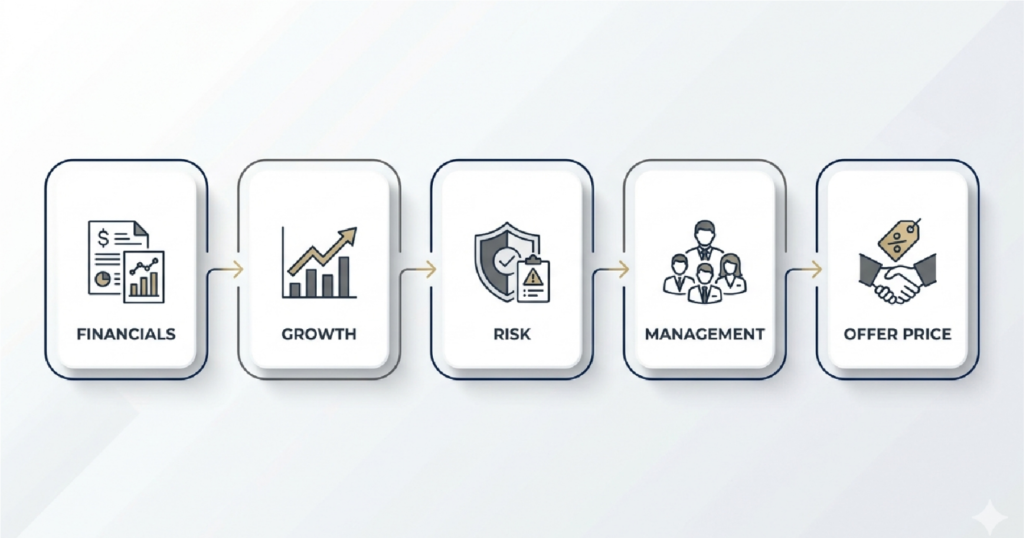
Many business owners assume buyers simply apply an industry multiple to revenue or EBITDA. In reality, sophisticated buyers evaluate much more than financial statements.
Every acquisition is ultimately a balance between expected return and perceived risk.
Buyers Purchase Future Earnings-Not Past Performance
Historical financial statements provide context, but buyers are investing in what the business is expected to generate after the acquisition.
They ask questions such as:
- Can revenue continue to grow?
- Will customers remain after the transition?
- Is the management team capable of operating independently?
- Are profit margins sustainable?
- What risks could reduce future earnings?
The answers to these questions directly influence valuation.
The Importance of Normalized EBITDA
Reported EBITDA rarely tells the full story.
Buyers adjust financial statements to calculate Normalized EBITDA, removing items that are unlikely to continue after the sale.
Common adjustments include:
- Owner’s excess compensation
- Personal expenses paid by the business
- Family members on payroll without operational roles
- One-time legal settlements
- Non-recurring consulting fees
- Temporary cost reductions
- Extraordinary income or expenses
These adjustments provide a clearer picture of the company’s true earning power.
Why Due Diligence Matters
A valuation is only the beginning. During due diligence, buyers verify every assumption behind the financial statements.
They review:
- Financial records
- Customer contracts
- Supplier agreements
- Tax filings
- Employee information
- Legal matters
- Intellectual property
- Operational processes
Unexpected issues uncovered during due diligence often result in:
- Purchase price reductions
- Deal restructuring
- Delayed closings
- Earn-out provisions
- In some cases, failed transactions
Valuation Example
Consider two manufacturing companies.
| Company A | Company B | |
| Annual Revenue | $15M | $15M |
| EBITDA Margin | 18% | 12% |
| Largest Customer | 12% | 55% |
| Recurring Revenue | High | Low |
| Management Team | Strong | Owner-dependent |
| Financial Reporting | Audited | Inconsistent |
Although both companies generate identical revenue, Company A presents lower risk and stronger long-term growth potential.
As a result, it may receive an EBITDA multiple of 7.5×, while Company B receives only 5×.
That difference could translate into millions of dollars in additional enterprise value, despite identical sales.
Expert Insight: Buyers rarely pay premium multiples for potential alone. They pay premium multiples for businesses that have already reduced risk, built scalable operations, and demonstrated sustainable profitability.
7 Practical Ways to Increase Your Business Value Before Selling

Improving valuation isn’t about making last-minute changes a few months before listing your business. The highest-value companies spend years building attractive, buyer-ready organizations.
Here are seven proven strategies that can significantly increase enterprise value.
1. Increase Recurring Revenue
Businesses with predictable, recurring income command higher valuation multiples because future cash flow is easier to forecast.
Consider:
- Subscription services
- Long-term contracts
- Service agreements
- Maintenance plans
- Repeat customer programs
2. Reduce Owner Dependency
If customers buy because of you rather than the company, buyers perceive greater risk.
Document processes, delegate responsibilities, and transition key customer relationships to your management team well before beginning a sale process.
3. Strengthen Financial Reporting
Reliable financial statements inspire buyer confidence.
Maintain:
- Accurate monthly reporting
- Clean bookkeeping
- Documented EBITDA adjustments
- Forecasts
- KPIs
- Budgeting systems
Well-organized financial records can significantly streamline due diligence.
4. Diversify Your Customer Base
Avoid relying heavily on one or two customers.
Reducing customer concentration lowers risk and makes revenue more sustainable.
5. Build a Strong Management Team
Businesses with experienced leadership teams often sell for higher multiples because buyers know operations can continue without the owner’s daily involvement.
Invest in leadership development, succession planning, and clearly defined responsibilities.
6. Improve Operational Efficiency
Look for opportunities to:
- Increase gross margins
- Automate repetitive processes
- Reduce unnecessary expenses
- Optimize inventory
- Improve production efficiency
- Strengthen supplier relationships
Operational excellence improves profitability and buyer confidence.
7. Prepare for Due Diligence Early
The best time to prepare for due diligence is long before a buyer requests documents.
Organize:
- Financial statements
- Corporate records
- Employee agreements
- Customer contracts
- Tax returns
- Licenses
- Compliance documentation
- Intellectual property records
Early preparation minimizes surprises and helps maintain negotiating leverage.
Frequently Asked Questions (FAQs)
1. How much is my business worth?
Your business value depends on several factors, including EBITDA, cash flow, industry trends, growth prospects, customer concentration, recurring revenue, and overall business risk. A professional valuation provides the most reliable estimate.
2. How is EBITDA used in business valuation?
EBITDA measures a company’s operating profitability. Buyers typically apply an industry-specific multiple to normalized EBITDA to estimate enterprise value.
3. How often should I get a business valuation?
Most privately held businesses benefit from an updated valuation every one to three years, or before major events such as selling, succession planning, raising capital, or partner buyouts.
4. Can I value my own business?
You can estimate your company’s value using industry benchmarks or online calculators, but these tools rarely account for business-specific risks, growth opportunities, or market conditions. A professional valuation is more accurate.
5. What documents are needed for a business valuation?
Typical documents include financial statements, tax returns, customer information, organizational charts, contracts, debt schedules, and operational data.
6. How long does a professional valuation take?
Depending on the complexity of the business, a comprehensive valuation typically takes between two and six weeks.
7. What factors reduce business value?
Common value detractors include declining revenue, owner dependency, poor financial reporting, customer concentration, inconsistent profitability, unresolved legal issues, and operational inefficiencies.
8. Should I hire an M&A advisor?
If you’re considering selling your business, an experienced M&A advisor can help position your company, identify qualified buyers, manage negotiations, coordinate due diligence, and maximize transaction value.
9. What’s the difference between a business valuation and a business appraisal?
Although the terms are often used interchangeably, a business valuation typically supports strategic planning and transactions, while an appraisal may be required for legal, tax, or regulatory purposes.
10. Can improving my business before selling really increase valuation?
Absolutely. Reducing risk, improving profitability, strengthening management, and preparing for due diligence can significantly increase buyer confidence and valuation multiples.
Conclusion
Your business is likely one of the most valuable assets you’ll ever own. Yet many owners wait until they’re ready to sell before asking the critical question: “How much is my business worth?”
By understanding how buyers evaluate businesses, improving key value drivers, and planning well in advance, you can position your company to command a stronger valuation and achieve a more successful exit.
Remember, valuation isn’t just about determining today’s worth-it’s about creating tomorrow’s value.
Whether you’re planning to transition ownership next year or a decade from now, obtaining a professional business valuation provides the clarity needed to make informed strategic decisions and maximize long-term wealth.
If you’re considering selling your business or beginning your exit planning journey, Horizon M&A can help you understand your company’s value, identify opportunities to enhance it, and guide you through every stage of the sell-side M&A process with confidence and confidentiality.