

What Buyers Review Before Acquiring a Contracting Business
Due diligence is the process buyers use to verify the information you've provided and understand the risks and opportunities within your business. For contractors, that goes well beyond financial statements — active projects, backlog, job profitability, licensing, bonding, and the people who run your projects all come under review.
Download the Guide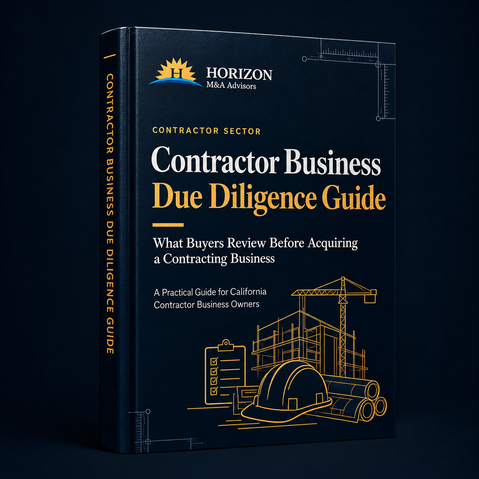
Understanding Due Diligence
Due diligence is the process buyers use to verify the information provided by a seller and understand the risks and opportunities within the business. For contracting businesses, due diligence goes well beyond financial statements — buyers may review active projects, backlog, job profitability, customer relationships, contracts, licensing, bonding, insurance, employees, subcontractors, and the systems used to manage projects.
The objective isn't simply to find problems. Buyers are trying to determine whether the business can continue producing reliable revenue and profitability after ownership changes.
Is the financial performance reliable?
Buyers want to confirm that reported revenue, gross profit, EBITDA, and cash flow accurately reflect the underlying business.
Is future revenue visible?
Buyers examine backlog quality, project concentration, contract terms, and the sales pipeline.
Are active projects performing as expected?
Work-in-progress schedules, job costing, remaining costs, change orders, and project margins can reveal potential future adjustments.
Can the business operate without the owner?
Management depth, project leadership, customer relationships, and documented processes can influence transition risk.
Industry Insight: For contractors, historical financial performance tells only part of the story. The quality of the current backlog and active projects can materially influence a buyer's view of future earnings.
What Buyers Typically Review
Buyers typically organize their due diligence around several major areas of the business. For contractors, these areas are closely connected because project performance ultimately affects revenue, margins, cash flow, and future earnings.
Financial Performance
Historical financial statements, EBITDA, cash flow, accounts receivable, accounts payable, and working capital.
WIP & Job Costing
Active project performance, estimated costs to complete, gross margins, change orders, and potential project exposure.
Backlog & Pipeline
Current backlog, remaining contract value, profitability, customer concentration, project timing, and future opportunities.
Customer Relationships
Major customers, repeat business, customer concentration, contracts, and relationships that may depend on the owner.
Contracts & Legal
Customer agreements, subcontractor contracts, disputes, claims, warranties, licenses, insurance, and other legal obligations.
Licensing & Bonding
Contractor licenses, bonding capacity, insurance coverage, safety records, and regulatory compliance.
Workforce & Management
Project managers, estimators, superintendents, foremen, administrative staff, key employees, and owner dependency.
Subcontractors & Suppliers
Key trade relationships, subcontractor concentration, supplier arrangements, pricing, and availability.
Buyers are evaluating whether the earnings, projects, relationships, and operating capabilities of the business are transferable after closing.
Building Financial Due Diligence Readiness
Contractor buyers often reconcile financial statements with WIP schedules and project-level job costing to understand whether reported earnings accurately reflect the performance of active projects.
Download the ChecklistBuilding Financial Due Diligence Readiness
Strong financial performance attracts buyers, but reliable financial information builds confidence during due diligence. For contractors, financial due diligence often requires a deeper review of project-level information.
01. Consistent Financial Reporting
Accurate financial statements that allow buyers to understand historical revenue, margins, EBITDA, and cash flow.
02. Revenue & Profitability Trends
Buyers evaluate revenue growth, gross margins, EBITDA, and whether profitability is supported by consistent project performance.
03. WIP Reporting
Accurate work-in-progress schedules help buyers evaluate active project revenue, costs incurred, estimated costs to complete, and expected margins.
04. Working Capital
Accounts receivable, retainage, accounts payable, and other operating requirements should accurately reflect the normal needs of the business.
05. Job Costing & Financial Systems
Reliable accounting and job-costing systems help connect project performance with reported financial results.
Strengthening Project & Operational Readiness
For contractors, operations directly determine whether backlog becomes profitable revenue. Buyers want confidence that active and future projects can be executed successfully without creating unexpected financial or operational risks.
Did you know? Buyers may review individual active projects in detail because a single underperforming project can affect future earnings and working capital.
Commercial Due Diligence: Understanding the Strength of Your Customer Base
A profitable contracting business is valuable, but buyers also want to understand where that revenue comes from and whether it is likely to continue after ownership changes.
Highest single-customer dependency
Secondary concentration exposure
Broader, diversified revenue
For illustration only. Actual concentration varies by business.
Customer Concentration
Does a significant percentage of revenue depend on one or two major customers?
Customer Relationships
Are relationships supported by long-term contracts, recurring work, or strong relationships across the organization?
Market Position
How does the business compete in its market, and what differentiates it from other contractors?
Backlog & Project Pipeline
Does the current backlog provide visibility into future revenue, and how strong is the pipeline beyond contracted work?
Sales Pipeline
Future orders, customer demand, and business development activities provide insight into future revenue opportunities.
A buyer doesn't simply want to know whether the business is compliant today. They want to understand whether licenses, contracts, insurance, and other critical requirements can continue supporting the business after the transaction.
Reviewing Contracts, Compliance & Risk
Contracting businesses operate within a complex network of customer agreements, subcontractor relationships, licenses, insurance requirements, and regulatory obligations.
Customer Contracts
Key agreements, payment terms, termination rights, warranties, indemnification, and assignment requirements.
Licensing & Bonding
Current contractor licenses, bonding capacity, insurance coverage, and requirements that may affect the ownership transition.
Safety & Compliance
Safety records, insurance claims, regulatory compliance, and any unresolved workplace or project-related issues.
Claims & Disputes
Pending or historical litigation, project disputes, warranty claims, liens, or other potential liabilities.
Contractual Risk
Obligations, guarantees, and other contract provisions that could create financial or operational exposure after closing.
Common Reasons Contractor Transactions Face Challenges
Due diligence issues don't necessarily mean a contracting business is weak. Many arise because information has not been organized, documented, or explained before buyers begin their review.
Inconsistent WIP Reporting
Differences between financial statements, WIP schedules, and actual project performance can create questions about earnings quality.
Unclear Project Profitability
Weak job-costing systems can make it difficult to determine whether active projects are on track to achieve expected margins.
Owner Dependency
If the owner controls major customers, estimating, project decisions, and problem resolution, buyers may perceive higher transition risk.
Customer Concentration
Heavy dependence on a limited number of customers can increase perceived revenue risk.
Backlog Risk
Large projects with uncertain margins, aggressive schedules, or unfavorable contract terms can create additional scrutiny.
Licensing or Compliance Issues
Unresolved licensing, bonding, insurance, safety, or regulatory matters may delay or complicate a transaction.
"If the business is profitable, due diligence should be straightforward." Not necessarily — buyers evaluate the quality, sustainability, and transferability of those profits, not just the historical numbers.
Contractor Due Diligence Readiness Assessment
Preparing for due diligence is a process, not a single event. Use these questions to identify the areas that may deserve additional attention before entering the market.
Due diligence preparation isn't about creating a perfect business. It's about demonstrating that the business is organized, transparent, and ready for buyer review.
Contractor Business Due Diligence Guide
What Buyers Review Before Acquiring a Contracting Business, Prepared by Horizon M&A Advisors
Before engaging buyers, take a moment to assess whether your business is prepared across the areas that typically influence buyer confidence during due diligence.
Financial Reporting
WIP & Job Costing
Backlog & Customers
Contracts & Compliance
Workforce & Management
Subcontractors & Suppliers
This checklist is intended to help you understand the major review categories buyers commonly evaluate. It is not a substitute for professional M&A advice. If you're planning to sell your contracting business, a confidential discussion with an experienced M&A advisor can help you identify potential gaps and prepare for a more efficient due diligence process.