
Horizon M&A Advisors

Contractor Business Sale Preparation

Before You Sell Your Construction Business, Know What Buyers Will Try to Discount.

WIP reporting. Project margins. Backlog quality. Customer concentration. Owner dependency. This free guide shows you what buyers will scrutinize when evaluating a contracting business, and what you can address before going to market.

Download the Checklist
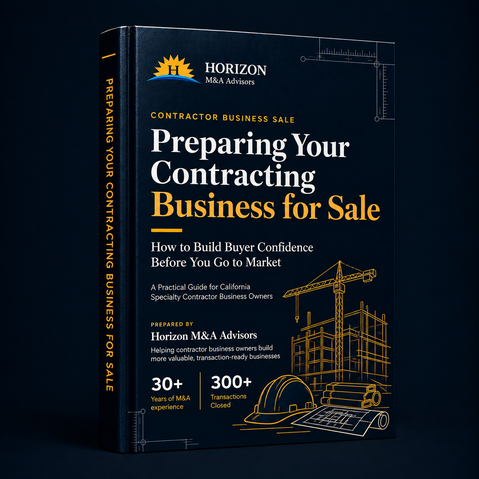
Contractor Business Sale Preparation Guide
Start Here

You Know How Good Your Business Is. Buyers Need to Prove It.

You may see strong backlog, long-term customers, experienced employees, healthy revenue, and years of successful projects. A buyer sees questions instead: how profitable is the backlog? How dependent is revenue on a few customers? Can the company operate without the owner? Are project margins actually repeatable? How accurate is the WIP reporting? What happens when the current owner leaves?

The difference matters. Anything a buyer cannot clearly understand, verify, or predict can become a risk discussion during valuation and due diligence.

Preparation Closes the Gap Between the Two

The same business can look very different from across the negotiating table. Our Contractor Sale Preparation Checklist helps you see it the way a buyer will, before they do.

Download the Checklist
What Makes Contractors Different

Selling a Contracting Business Isn't the Same as Selling a Typical Business

Contractors have unique factors that can materially affect how buyers evaluate the company.

WIP & Job Costing

Can you clearly demonstrate how current projects are performing?

Backlog

Is future revenue supported by quality contracts and sustainable margins?

Project Concentration

Does one project represent a disproportionate amount of future revenue?

Customer Concentration

How much revenue depends on your largest customers?

Owner Dependency

What happens when the owner stops estimating, selling, managing, or solving problems?

Management Depth

Who actually runs the business day to day?

Licensing & Compliance

Are licenses, insurance, safety records, contracts, and regulatory requirements organized?

Equipment & Debt

What does the company own, lease, owe, and actually need to operate?

Advisor Insight

The most expensive problems are often the ones you discover after a buyer does. Preparation gives you time — time to fix, time to document, time to strengthen, time to build a better story around the business.

You Can Still Address These Issues — Before Buyers Are Involved

Once buyers are involved, your negotiating environment changes. Preparing now keeps the options in your hands.

Download the Preparation Checklist
See It Their Way

The Same Business Can Look Very Different From Across the Negotiating Table

01

"A large backlog speaks for itself."

A buyer investigates the quality and profitability of that backlog, not just its size — contract terms, expected margins, and completion timelines all matter.

02

"Loyal customers mean stability."

A buyer looks at customer concentration and retention. Loyalty to the business, not just to the owner, is what carries value through a transition.

03

"Strong EBITDA is enough."

A buyer wants to understand the sustainability and normalization of that EBITDA — what's repeatable, and what was a one-time result.

04

"A great project history guarantees future performance."

A buyer examines the consistency of project margins across jobs, not just the headline wins.

The Framework

The Contractor Sale-Readiness Framework

Six areas buyers evaluate before making an offer on a contracting business.

01. Financial Readiness — information buyers can understand, reconcile, and defend
02. Project Profitability — what historical projects tell a buyer about future performance
03. Backlog Quality — why the backlog is valuable, not just how much of it there is
04. Owner Independence — where the business still depends on you
05. Management Depth — a leadership structure that makes the company easier to transfer
06. Due Diligence Readiness — finding the issues before buyers do

Preparation is about strengthening these six areas well before you enter the market.

Consider These Questions

Questions Worth Asking Before Going to Market

Can you clearly explain how your backlog is priced and margined?
Is a disproportionate share of revenue tied to one customer or one project?
Could the business operate if you stepped back from estimating and selling?
Are your job costing and WIP reports current and accurate?
Are licenses, insurance, and safety records fully organized?
Do key employees understand their responsibilities if you stepped back?
Would your management team confidently support buyer due diligence?

If several of these questions create uncertainty, additional preparation may help strengthen buyer confidence before entering the market.

Contractor Sale-Readiness Checklist

20+ Contractor-Specific Preparation Checkpoints, Prepared by Horizon M&A Advisors

Don't just give buyers another PDF. Use this as a practical diagnostic tool to assess where your business stands before you go to market.

Financial Readiness

Financial statements and tax returns are complete and reconciled.
EBITDA is normalized for owner compensation and one-time expenses.
Working capital is actively monitored.
Accounts receivable and payable are current and well documented.

Project Profitability

Job costing and gross margins are tracked by project.
Change orders are documented and their impact understood.
Cost overruns and project write-downs are explainable.
Historical project performance is organized and reviewable.

Backlog Quality

Contract value and remaining revenue are documented by project.
Expected margins on backlog work are understood, not assumed.
Project and customer concentration within the backlog has been reviewed.
Contract terms and completion timelines are organized.

Owner Independence

Sales and estimating do not depend solely on the owner.
Customer relationships extend beyond the owner.
Project management and vendor relationships are delegated.
Strategic decisions can be made without the owner in the room.

Management Depth

Key employees and their responsibilities are clearly defined.
Decision-making authority is shared beyond the owner.
Retention and succession plans exist for critical roles.
Institutional knowledge is documented, not held in one person's head.

Due Diligence Readiness

Contracts, licensing, and insurance documentation are organized.
Safety records and compliance documentation are current.
Litigation and employee matters have been reviewed.
Equipment ownership, leases, and related debt are documented.

This checklist is intended to help you understand the areas buyers commonly evaluate. It is not a substitute for professional M&A advice. If you're planning to sell your contracting business in the next few years, a confidential discussion with an experienced M&A advisor can help you better understand your readiness and identify opportunities to strengthen buyer confidence before going to market.

Common Questions

Frequently Asked Questions

Start by strengthening the areas buyers scrutinize most: WIP reporting, backlog quality, customer concentration, and owner dependency. Ideally this begins one to five years before your intended exit.
Value depends on EBITDA, backlog quality, customer and project concentration, management depth, and licensing/compliance readiness, among other factors. A confidential conversation with an advisor gives you a more specific read than a rule of thumb.
Typically several years of financial statements and tax returns, WIP and job-costing reports, backlog documentation, accounts receivable/payable detail, and evidence of normalized EBITDA.
Significantly. Buyers evaluate the quality, margin, and concentration of backlog, not just its total value. A large backlog concentrated in one project or customer can raise more questions than it answers.
WIP reporting is how buyers verify that current projects are performing as represented. Inaccurate or inconsistent WIP reporting is one of the fastest ways to lose buyer confidence during due diligence.
Buyers discount businesses where estimating, selling, customer relationships, or problem-solving all run through the owner. A company that can operate without the founder's daily involvement is easier to underwrite and easier to transfer.
Meaningful preparation typically takes one to three years, though owners further from an exit benefit from starting even earlier. The earlier you start, the more options you have.
Start with WIP reporting accuracy, customer and project concentration, owner dependency, and management depth — the factors buyers most commonly flag as risks during due diligence.
Yes. A directional valuation helps you set realistic expectations and identify which value drivers are worth strengthening before you go to market.
Buyers typically apply a multiple to normalized EBITDA, then adjust based on backlog quality, customer and project concentration, management depth, licensing and compliance, and equipment/debt position.

See How Sale-Ready Your Business Is

Tell us a bit about your business and we will send your download right away.

Scroll to Top