

Business owners often assume that if their company’s revenue and EBITDA remain strong, its value should remain unchanged. In reality, interest rates can significantly influence business valuation multiples, even when the business itself is performing just as well as it did a year ago.
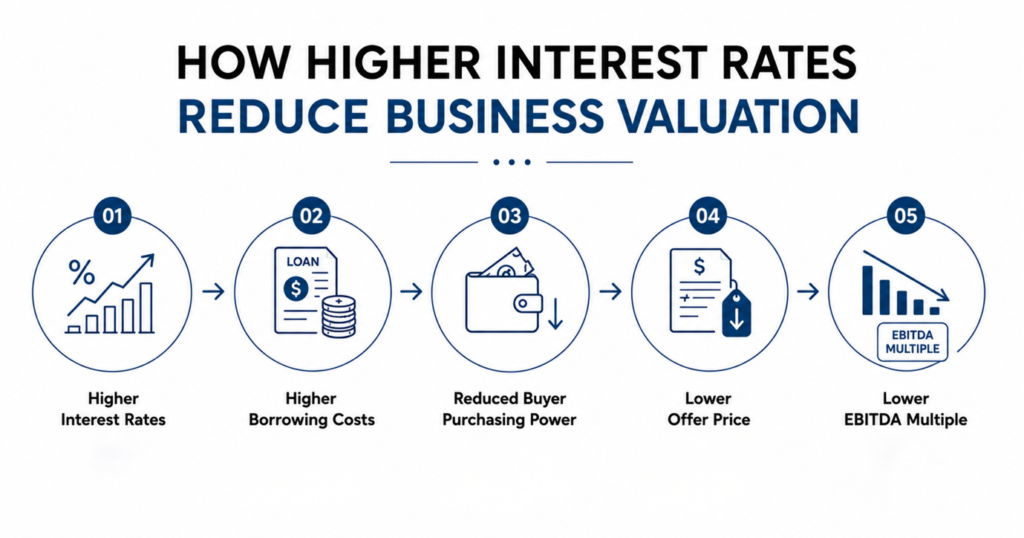
Higher interest rates increase the cost of financing acquisitions, reduce buyer purchasing power, and raise the return buyers expect on their investments. The result is that many buyers lower the EBITDA multiple they are willing to pay, which directly impacts your overall business valuation.
If you’re planning on selling a business within the next one to five years, understanding this relationship can help you make better decisions about timing, preparation, and valuation expectations.
Key Takeaway
Business performance determines how much profit you generate. Market conditions determine how much buyers are willing to pay for those profits.
Why This Matters More for Sub-$20M Businesses
Not every acquisition is affected equally by changes in interest rates.
Most lower middle market M&A transactions involve businesses valued below $20 million. These acquisitions are commonly financed using a combination of buyer equity and bank debt. When borrowing costs increase, buyers have less financial flexibility and often reduce their purchase price to maintain their target investment returns.
For larger companies, access to institutional capital and alternative financing structures may soften the impact. For smaller privately held businesses, however, financing costs can directly influence the valuation buyers are willing to offer.
This is why understanding interest rates and business valuation is especially important for owners preparing for an exit.
If you haven’t established your company’s current value, a professional Business Valuation is the best starting point before deciding whether today’s market conditions align with your exit goals.
Advisor Insight
Many owners blame declining valuations on market conditions alone. In our experience, market conditions influence the multiple, but the quality of the business still determines whether buyers compete aggressively or negotiate aggressively.
How Buyers Actually Value a Business
One of the biggest misconceptions among business owners is that buyers simply estimate what a company is “worth.”
Professional buyers use structured valuation methods, with one of the most common approaches being the EBITDA multiple.
The formula is straightforward.
Enterprise Value = EBITDA × Valuation Multiple
For example:
| EBITDA | EBITDA Multiple | Estimated Business Valuation |
| $2 Million | 8.0× | $16 Million |
| $2 Million | 7.0× | $14 Million |
| $2 Million | 6.0× | $12 Million |
Notice what changed.
The company’s EBITDA remained exactly the same.
Only the multiple changed.
That single adjustment reduced the company’s value by $4 million.
This is why business valuation multiples matter just as much as improving profitability. Increasing EBITDA certainly creates value, but market conditions determine how buyers price those earnings.
Why Interest Rates Affect Business Valuation Multiples
Many business owners ask a simple question:
“If my business is performing well, why would higher interest rates reduce what buyers are willing to pay?”
The answer lies in how acquisitions are financed and how investors evaluate risk.
Interest rates do not change your company’s earnings overnight.
They change the economics of buying your business.
Let’s look at the four biggest reasons.
1. Buyers Pay More to Finance an Acquisition
Few acquisitions are completed entirely with cash.
Strategic buyers, private equity firms, and search funds frequently use debt to finance part of an acquisition. Lower borrowing costs allow buyers to finance larger transactions while maintaining attractive returns.
When interest rates increase:
- Loan repayments become more expensive.
- Banks often tighten lending standards.
- Buyers contribute more equity.
- Total purchasing power declines.
To offset these higher financing costs, buyers frequently reduce the purchase price they are willing to offer.
This is one of the most direct ways how interest rates affect business valuation.
Key Takeaway
Higher interest rates rarely change the quality of your business. They change how much buyers can afford to pay.
2. Investors Expect Higher Returns
Every acquisition competes against other investment opportunities.
When interest rates are low, buyers may accept lower returns because alternative investments generate modest yields.
As interest rates rise, safer investments become more attractive. Buyers therefore expect acquisitions to generate stronger returns to justify the additional risk.
Instead of accepting lower returns, buyers usually lower the acquisition price.
That adjustment often appears as a lower EBITDA multiple rather than a direct reduction in the perceived quality of the business.
This explains why M&A valuation fluctuates even when company performance remains consistent.
3. Debt Creates Less Buying Power
Leverage has long been a key driver of acquisition activity.
In many lower middle market transactions, buyers finance a significant portion of the purchase price through debt. Affordable financing allows them to pay higher valuation multiples while still achieving acceptable investment returns.
When financing becomes more expensive, leverage becomes less efficient.
A buyer faced with higher interest costs generally has three options:
- Invest more equity.
- Offer a lower purchase price.
- Walk away from the transaction.
In most cases, lowering the purchase price becomes the preferred solution.
This is why many owners notice declining business valuation multiples during periods of rising interest rates, even though demand for quality businesses still exists.
This is also why buyers conduct a thorough Quality of Earnings (QoE) analysis during due diligence. A QoE review goes beyond reported EBITDA to determine whether earnings are sustainable, recurring, and supported by the company’s financial records. If a QoE analysis uncovers aggressive add-backs or inconsistent cash flow, buyers may reduce the valuation multiple even further.
Understanding Quality of Earnings (QoE) Adjustments
4. Buyers Become More Selective
Higher interest rates do not stop acquisitions.
They simply raise the standard.
Today’s buyers are looking for businesses with:
- Predictable cash flow
- Recurring revenue
- Diversified customers
- Strong management teams
- Healthy EBITDA margins
- Proven growth opportunities
Businesses with these characteristics often continue attracting multiple buyers, even in a higher-rate environment.
Companies with customer concentration, inconsistent earnings, or operational inefficiencies typically experience greater pressure on valuation multiples.
Owners preparing for a future exit should focus on improving these fundamentals rather than trying to predict future interest rate movements.
Customer Concentration Discounts Explained
Comparison Table
| Businesses That Hold Value Better | Businesses That Face Greater Pressure |
| Recurring revenue | Project-based revenue |
| Diversified customers | Heavy customer concentration |
| Predictable cash flow | Volatile earnings |
| Strong management team | Owner-dependent operations |
| Scalable growth | Limited expansion opportunities |
This comparison helps explain why two companies with identical EBITDA can receive very different valuation multiples.
A Real-World Example: How Interest Rates Can Change Business Valuation
Let’s look at a simplified example based on a typical lower middle market M&A transaction.
A manufacturing company generates $2.5 million in EBITDA. The business has stable customers, healthy margins, and experienced management. Operationally, nothing changes over the next two years.
The only major difference is the financing environment.
Scenario 1: Lower Interest Rate Environment
| Metric | Value |
| EBITDA | $2.5 Million |
| EBITDA Multiple | 8.2× |
| Enterprise Value | $20.5 Million |
At this point, buyers have access to relatively inexpensive financing. Banks are lending confidently, acquisition activity is strong, and competition among buyers supports higher business valuation multiples.
Scenario 2: Higher Interest Rate Environment
| Metric | Value |
| EBITDA | $2.5 Million |
| EBITDA Multiple | 6.9× |
| Enterprise Value | $17.25 Million |
Although the company’s financial performance hasn’t changed, the market has.
Higher borrowing costs reduce buyers’ purchasing power, lenders become more selective, and investors expect stronger returns. As a result, buyers lower the multiple they are willing to pay.
The company’s EBITDA remains identical.
Its business valuation falls by more than $3 million.
Key Takeaway
Your business value is influenced by both company performance and market conditions. Strong earnings alone do not guarantee the same valuation multiple in every economic environment.
Does Every Business Lose Value When Interest Rates Rise?
No.
This is one of the biggest misconceptions among business owners.
Higher interest rates generally place downward pressure on business valuation multiples, but exceptional businesses often continue to command premium valuations.
Buyers are willing to pay more for companies that reduce risk and create confidence.
These businesses typically have:
- Recurring or contracted revenue
- Diversified customers
- Strong cash flow
- Healthy EBITDA margins
- Experienced management beyond the owner
- Clear opportunities for future growth
For example, imagine two companies each generating $3 million in EBITDA.
One has 300 recurring customers, low employee turnover, and a professional management team.
The other relies on three major customers and the owner manages every key relationship.
Although both businesses generate the same earnings, buyers will almost always assign different multiples because the level of risk is different.
Comparison Table
| Premium Multiple Business | Discounted Multiple Business |
| Recurring revenue | One-time project revenue |
| Diverse customer base | High customer concentration |
| Strong management team | Owner-dependent |
| Predictable cash flow | Inconsistent cash flow |
| Documented processes | Informal operations |
Advisor Insight
In our experience, buyers rarely pay premium multiples simply because interest rates are low. Premium valuations are earned through strong fundamentals, disciplined operations, and confidence that future earnings are sustainable.
Should You Wait for Interest Rates to Fall Before Selling?
Many business owners postpone selling because they believe lower interest rates will automatically increase their company’s value.
Sometimes that happens.
Often, it doesn’t.
Interest rates are only one factor that influences M&A valuation.
Buyers also evaluate:
- Revenue quality
- EBITDA growth
- Industry outlook
- Customer concentration
- Management depth
- Competitive positioning
- Quality of financial reporting
Waiting for interest rates to decline while ignoring these fundamentals can actually reduce the value of your business.
For example, delaying a sale by two years could expose your company to:
- Declining industry demand
- Customer losses
- New competitors
- Owner burnout
- Economic uncertainty
On the other hand, improving EBITDA, reducing customer concentration, and preparing thoroughly for due diligence often create significantly more value than trying to predict future interest rate movements.
If you’re considering an exit within the next few years, developing a structured Business Exit Strategy can help you maximize value regardless of where interest rates move.
Key Takeaway
You cannot control interest rates.
You can control how attractive your business is to buyers.
Five Practical Ways to Maximize Business Value in Any Interest Rate Environment
Business owners often ask what they should focus on when market conditions become less favourable.
The answer is simple.
Improve the factors buyers value most.
1. Increase EBITDA
Growing sustainable earnings remains one of the most effective ways to increase business valuation.
Higher profitability can offset some pressure from lower valuation multiples.
2. Build More Recurring Revenue
Businesses with recurring revenue are often viewed as lower-risk investments because future cash flow is more predictable. Subscription models, long-term service agreements, and recurring customer relationships can help companies command premium business valuation multiples during an acquisition.
Learn more about why recurring revenue commands a premium in M&A transactions.
Why Recurring Revenue Commands a Premium
3. Reduce Customer Concentration
Heavy dependence on one or two customers increases perceived risk and can lead to customer concentration discounts during a business sale. Diversifying your customer base strengthens buyer confidence and can support higher valuation multiples.
Learn how customer concentration discounts can affect your business valuation before going to market.
4. Prepare for Due Diligence Before Going to Market
One of the fastest ways to lose negotiating leverage is entering due diligence unprepared.
Clean financial statements, documented processes, organized contracts, and credible earnings build buyer confidence.
5. Create Competition Among Buyers
Businesses sold through a structured sale process often receive stronger offers than those marketed to a single buyer.
Competition encourages buyers to focus on long-term strategic value rather than negotiating solely on price.
Common Mistakes Business Owners Make
Even experienced entrepreneurs can make decisions that reduce business value.
Avoid these common mistakes.
Waiting for the “Perfect” Market
Trying to time interest rates is rarely a successful exit strategy.
Focus on preparing your business instead.
Focusing Only on EBITDA
Strong earnings matter, but buyers also evaluate risk, scalability, and future growth.
Ignoring Operational Improvements
Customer diversification, management development, and recurring revenue often influence valuation multiples just as much as financial performance.
Starting Exit Planning Too Late
Preparing a business for sale typically takes months, not weeks.
Early planning creates more options and stronger negotiating power.
Advisor Perspective
The best exits rarely happen because the market was perfect.
They happen because the business was prepared.
Frequently Asked Questions
How do interest rates affect business valuation?
Higher interest rates increase borrowing costs, reduce buyer purchasing power, and raise investors’ return expectations. As a result, buyers often lower the EBITDA multiple they are willing to pay, reducing overall business valuation.
Do higher interest rates always reduce business valuation multiples?
No. Businesses with recurring revenue, diversified customers, predictable cash flow, and strong management teams often continue to command premium multiples despite higher interest rates.
Should I wait until interest rates fall before selling my business?
Not necessarily. Improving business fundamentals such as EBITDA growth, recurring revenue, and due diligence readiness often has a greater impact on valuation than waiting for lower interest rates.
Why is EBITDA multiple important?
The EBITDA multiple determines how buyers convert annual earnings into enterprise value. Even if EBITDA remains constant, a lower multiple can significantly reduce business valuation.
Are buyers still acquiring businesses during periods of high interest rates?
Yes. Strategic buyers, private equity firms, and search funds continue to complete acquisitions. However, they tend to be more selective and prioritize businesses with predictable earnings and lower operational risk.
Final Thoughts
Understanding how interest rates affect business valuation helps business owners make better decisions long before they enter the market.
Higher interest rates can influence business valuation multiples, but they do not determine the outcome of every transaction. Buyers continue to pay premium valuations for businesses with strong financial performance, recurring revenue, experienced management, and clear growth opportunities.
Rather than trying to predict where interest rates will move next, focus on building a business that buyers value in any market.
If you’re planning on selling a business within the next one to five years, now is the time to understand your company’s current market value, identify opportunities to strengthen it, and prepare for a successful exit.
Whether you’re just beginning your exit planning or evaluating current market conditions, our advisors can help you understand how today’s interest rate environment may affect your business and what you can do to maximize its value.
Ready to understand what your business is worth in today’s market?
Schedule a confidential consultation with Horizon M&A Advisors to discuss your valuation, exit strategy, and the steps that can help position your business for the strongest possible outcome.
Related Resources