

Every HVAC owner who has spent years building routes, training technicians, winning service contracts, and answering emergency calls eventually asks the same question: what is this business actually worth?
In 2026, the answer is not a single industry multiple. Smaller owner-operated HVAC businesses are generally valued on Seller’s Discretionary Earnings (SDE), while larger, professionally managed companies are more often valued on EBITDA. Within either method, the quality and transferability of the earnings matter just as much as the earnings themselves.
The Short Answer
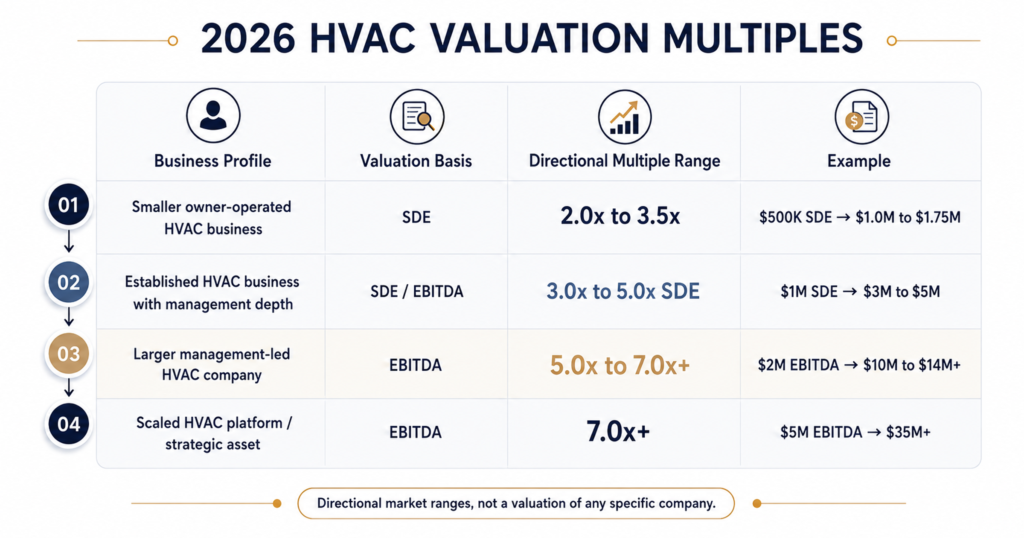
Current market sources point to a broad range rather than one universal HVAC multiple. BizBuySell’s reported national HVAC transactions show average earnings multiple of 2.68x in 2025, with a five-year average of 2.75x. Other industry-focused sources place stronger HVAC businesses higher, particularly where recurring revenue, management depth and buyer competition are present. Larger professionally managed companies can command substantially higher EBITDA multiples than small owner-operated shops.
| Business profile | Typical valuation basis | Illustrative range | What pushes it higher |
| Small owner-operated HVAC shop | SDE | Approximately 2.0x–3.5x | Recurring service revenue, clean books, low owner dependency |
| Stronger established HVAC company | SDE / EBITDA | Approximately 3.0x–5.0x SDE or 5.0x–7.0x+ EBITDA | Management depth, growth, diversified customers, maintenance agreements |
| Platform-quality HVAC operator | EBITDA | Approximately 7.0x–10.0x+ in stronger cases | Scale, recurring revenue, multi-branch operations, strong management |
| Large consolidation platform | EBITDA / transaction-specific | Can exceed the ranges above | Scale, strategic fit, synergies, growth and competitive buyer process |
These are directional market ranges, not a quote for any specific company. The range should be treated as a starting point for valuation analysis, not an asking price. Publicly available databases capture only part of the private HVAC market, and reported transaction multiples can differ by business size, buyer type, geography, deal structure and earnings definition.
A More Useful Way to Think About HVAC Value
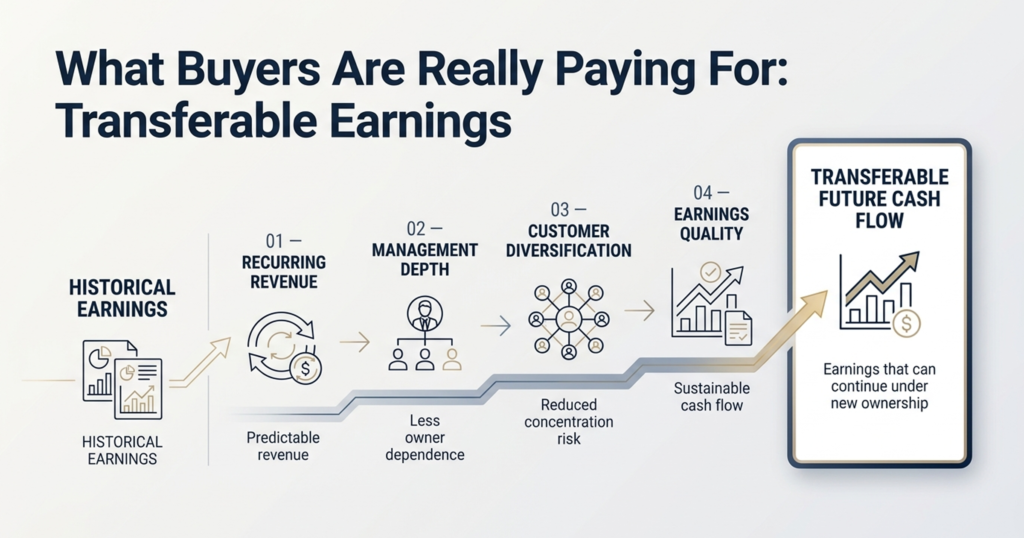
The most important question is not simply, “What multiple does HVAC trade at?” It is, “How transferable are this company’s earnings to the next owner?”
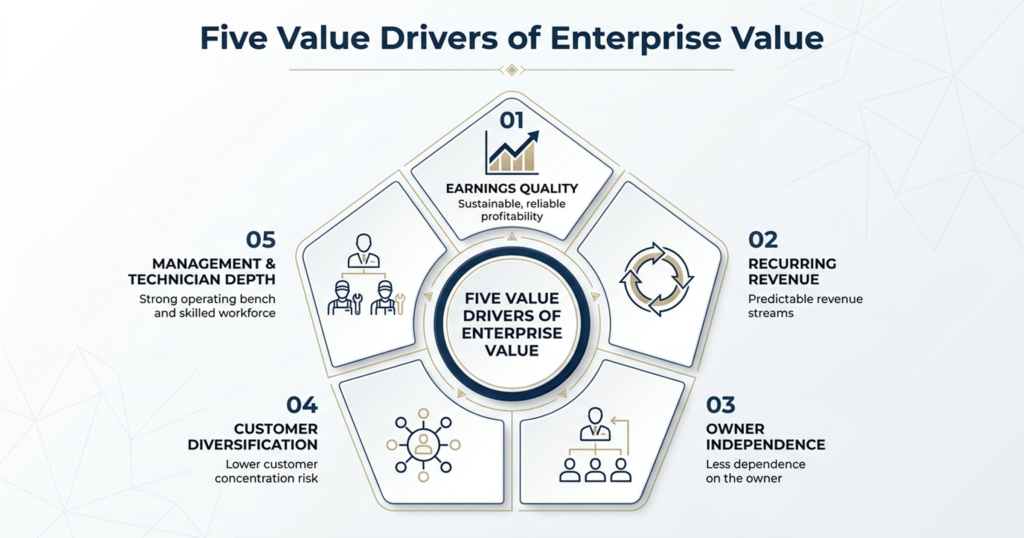
Two HVAC businesses can produce the same EBITDA and still receive very different offers. Buyers pay more when they believe the earnings are durable, diversified and capable of continuing without the founder. That is the core idea behind the five drivers below.
The 5 Drivers of HVAC Enterprise Value
1. Earnings quality
Buyers normalize the financial statements before applying a multiple. Legitimate owner add-backs and one-time expenses can improve normalized earnings, but unsupported adjustments can be challenged during Quality of Earnings work and may lead to a lower valuation or a re-trade.
2. Recurring revenue
Maintenance agreements and other recurring service relationships make future revenue more predictable. The quality of those contracts matters more than simply reporting a high percentage of recurring revenue. Renewal behavior, contract economics, customer retention and service history all matter.
3. Owner independence
If the owner personally controls sales, dispatch, estimating, customer relationships and major operating decisions, the buyer is taking on transition risk. A capable management layer and documented processes can make the earnings more transferable.
4. Customer diversification
A large customer can be valuable, but excessive concentration creates risk. If one account represents a material share of revenue, buyers will examine contract terms, renewal history, relationship ownership and what happens if that account leaves.
5. Management and technician depth
A stable technician base, experienced field leadership and an organization that can operate without the owner reduce execution risk. In a labor-constrained service market, the ability to retain and recruit skilled technicians can materially affect buyer confidence.
Why Buyer Demand Remains Important in 2026
HVAC continues to attract strategic and private equity-backed buyers because the service is essential, the installed equipment base creates ongoing replacement and maintenance demand, and the industry remains fragmented. Recent transactions and financing activity illustrate the scale of institutional interest. For example, Reuters reported in March 2026 that American Residential Services was exploring a sale that could value the company above $3.5 billion. In June 2026, The Wall Street Journal reported that Apollo Global Management invested $2 billion for a minority stake in Apex Service Partners at a valuation of approximately $10 billion.
Those large transactions should not be used as direct comps for a local HVAC company. They do, however, demonstrate that well-capitalized buyers continue to see value in scaled residential and commercial service platforms. For smaller businesses, the relevant buyer may instead be an individual operator, search fund, strategic acquirer or regional platform.
Buyer interest also does not mean every HVAC company receives a premium multiple. Financing conditions, growth expectations, diligence findings and the quality of the target all influence the final offer. Strong buyer demand can create opportunity, but the business still has to withstand underwriting.
Buyer Type Changes the Deal
| Buyer type | Typical fit | What they may prioritize |
| Individual / ETA buyer | Smaller owner-operated companies | Cash flow, owner transition, SBA or conventional financing, manageable operations |
| Search fund / independent sponsor | Growing businesses with identifiable management potential | Earnings quality, growth, transition plan, financing capacity |
| Strategic buyer | Companies with geographic or service overlap | Synergies, customer base, technicians, market position, cross-selling |
| Private equity-backed platform | Larger, management-led HVAC businesses | Scale, recurring revenue, EBITDA growth, management depth, add-on potential |
What Can Move Your HVAC Valuation Higher?
- Build recurring maintenance revenue before a sale process begins.
- Reduce owner dependency by creating a management structure that can operate without you.
- Diversify revenue so no single customer creates outsized risk.
- Clean up financial reporting and document legitimate add-backs well before a buyer performs diligence.
- Track technician retention, productivity and field leadership so the buyer can understand the strength of the operating team.
- Maintain clear customer, contract and service records that demonstrate the durability of the revenue base.
- Understand which buyer universe your company actually fits before assuming a private equity multiple applies.
These improvements are not last-minute cosmetic changes. The strongest valuation outcomes usually come from businesses that have been prepared months or years before an owner signs an LOI.
The California Perspective
For California HVAC owners, valuation should be considered in the context of the local labor market, customer mix, geographic density, service territory, recurring maintenance base and the buyer’s existing footprint. A buyer evaluating a California HVAC company is not simply asking whether the business is profitable. The buyer is also assessing how easily the operation can be integrated, expanded or managed after the transaction.
That makes preparation especially important for owners considering a sale in California. The right valuation is not just a multiple applied to last year’s earnings. It is an assessment of normalized earnings, business quality, market position, buyer fit and the risks a buyer will inherit.
Curious what your HVAC business could be worth? Start with a valuation estimate.
Get an initial estimate of your HVAC business valuation, then understand what could move that number higher or lower.
Calculate Your Business Valuation
If you’re considering a sale, recapitalization, partnership or strategic transition, Horizon M&A Advisors can help you understand the value of your business before you make a major decision.
We’ll look beyond a generic industry multiple to assess the factors that can materially influence your valuation, including normalized earnings, recurring revenue, customer concentration, management depth, owner dependency and buyer fit.
Get a confidential opinion of value for your HVAC business.
Book a Confidential Valuation Consultation →
No obligation. Confidential discussion. Built around your specific business.
Not Ready to Talk About a Sale?
You don’t have to be ready to go to market to understand whether your business is prepared for one.
Take the Exit Readiness Assessment →
Frequently Asked Questions
How much is my HVAC business worth if I have $800,000 in SDE?
A broad market benchmark could place an owner-operated HVAC business around the low-to-mid single-digit SDE range, but the exact multiple depends on recurring revenue, owner involvement, customer concentration, growth and financial quality. For example, 2.5x to 4.0x would imply approximately $2.0 million to $3.2 million of enterprise value before considering transaction-specific adjustments. A formal valuation is required to narrow the range for a specific company.
What is a typical HVAC business valuation multiple in 2026?
There is no single 2026 multiple. BizBuySell reported average earnings multiple of 2.68x for HVAC businesses sold in 2025, while other industry sources report higher ranges for stronger businesses and larger professionally managed companies. The appropriate multiple depends heavily on business size, earnings basis, recurring revenue, management depth and buyer type.
Is SDE or EBITDA used to value an HVAC business?
Smaller owner-operated businesses are commonly evaluated using SDE because the owner’s compensation and role are embedded in the earnings measure. Larger businesses with management in place are more commonly valued using EBITDA. The transition is not triggered by a universal dollar threshold. It depends on the economics and operating structure of the company.
Do I need audited financial statements to sell my HVAC business?
Not necessarily. Many lower middle-market transactions do not require audited financial statements. Buyers will, however, scrutinize the financial statements and may conduct a Quality of Earnings review. Clean monthly reporting, consistent accounting and well-supported add-backs can materially reduce diligence friction.
Will private equity buyers always pay more than an individual buyer?
No. Private equity-backed platforms can have greater acquisition capacity and may pay premium prices for strategic fit, scale and recurring revenue, but they also have underwriting requirements and return thresholds. The highest headline offer is not always the best transaction once structure, rollover equity, earnouts, working capital and other terms are considered.
Is 2026 a good time to sell an HVAC business?
Market demand remains constructive, but timing should be based on both market conditions and business readiness. A well-prepared company with clean financials, recurring revenue and low owner dependency is generally better positioned to attract competitive interest than a business rushed to market simply because buyers are active.