

A retrade occurs when a buyer attempts to renegotiate price or deal terms after signing a Letter of Intent (LOI), typically during due diligence. Buyers retrade when they uncover new risks, question financial assumptions, detect performance changes, or reassess market conditions. While some retrades are justified, many are preventable. Sellers who prepare thoroughly, control the narrative, and manage diligence proactively significantly reduce the risk of post-LOI price reductions.
What Is a Retrade in M&A?
In mid-market M&A, signing a Letter of Intent often feels like the finish line.
In reality, it is the beginning of the most scrutinized phase of the transaction: due diligence.
A retrade happens when a buyer revises the agreed purchase price or key terms after the LOI, usually citing new findings or updated risk assessments.
Retrades typically involve:
- Lower valuation multiples
- Increased escrow holdbacks
- Expanded earn-outs
- Reduced cash at close
- Stricter indemnification terms
For sellers, retrades can feel like a broken promise. For buyers, they are framed as “adjustments based on diligence findings.”
Understanding why retrades happen is the first step toward preventing them.
Why Buyers Retrade After LOI
1. Financial Quality of Earnings Issues
One of the most common triggers for a retrade is financial inconsistency.
Buyers often uncover:
- Revenue recognition issues
- Non-recurring revenue counted as recurring
- Overstated EBITDA adjustments
- Margin volatility is not disclosed upfront
If the quality of earnings (QOE) review contradicts the initial presentation, buyers use this gap as leverage.
Seller insight: Overly aggressive EBITDA normalization is one of the fastest paths to a retrade.
2. Performance Softening During Diligence
Deals often take 60–120 days between LOI and closing.
If during that window:
- Revenue declines
- Key customers churn
- Margins compress
- Pipeline weakens
Buyers may argue the business is no longer worth the agreed price.
In volatile industries, even minor performance dips can prompt repricing discussions.
3. Undisclosed Risks or Surprises
Unexpected findings in diligence can lead to retrades, including:
- Customer concentration issues
- Supplier instability
- Pending litigation
- Compliance gaps
- Technical debt (in SaaS deals)
Buyers expect transparency. Surprises weaken trust and negotiating leverage.
4. Overly Optimistic Forecasts
Some LOIs are based on projected growth rather than trailing performance.
If buyers lose confidence in:
- Growth assumptions
- Market demand
- Competitive positioning
They may push to restructure the deal with earn-outs or lower upfront cash.
5. Market or Financing Changes
Interest rate shifts, tightened lending standards, or broader economic uncertainty can impact financing availability.
In leveraged deals, buyers may cite external capital constraints as justification for revisiting valuation.
While macro conditions are outside the seller’s control, preparation can still protect leverage.
How Sellers Can Prevent Retrades
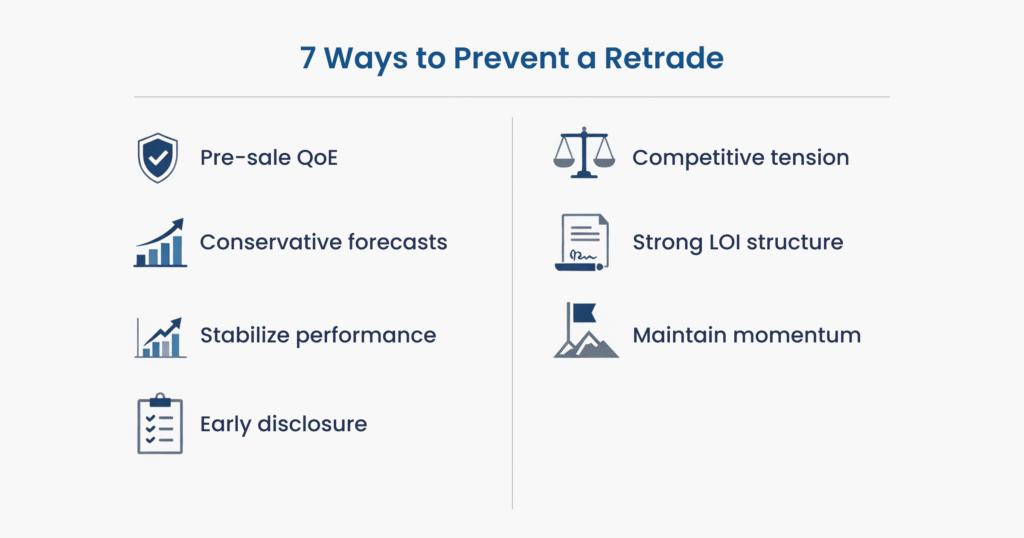
1. Conduct Pre-Sale Diligence
One of the most effective strategies is running a sell-side quality of earnings review before going to market.
This allows sellers to:
- Identify accounting inconsistencies
- Normalize EBITDA correctly
- Anticipate buyer objections
- Address weaknesses proactively
When financial clarity exists upfront, buyers have fewer levers to pull later.
2. Present Conservative, Credible Forecasts
Under promise. Overdeliver.
Forecasts that are too aggressive invite scepticism. Buyers prefer realistic projections supported by historical performance.
Credibility protects valuation.
3. Stabilize Performance Before Going to Market
Launching a sale process during volatile performance increases retrade risk.
Before signing an LOI:
- Ensure revenue trends are stable
- Lock in key contracts
- Address customer churn risks
- Reduce margin volatility
Consistency reduces buyer uncertainty.
4. Disclose Risks Early
Transparency builds leverage.
If there are:
- Customer concentration issues
- Pending disputes
- Compliance gaps
Address them proactively in initial materials rather than allowing buyers to “discover” them during diligence.
Surprises weaken negotiating power.
5. Create Competitive Tension
Retrades are less likely when buyers believe:
- Competing bidders remain interested
- The seller can walk away
- Alternatives exist
Single-buyer negotiations increase retrade risk.
A well-managed process preserves leverage.
6. Manage the LOI Carefully
Not all LOIs are equal.
Key LOI protections include:
- Clear definitions of adjusted EBITDA
- Defined working capital targets
- Limited exclusivity periods
- Explicit deal structure terms
Ambiguity at the LOI stage creates space for retrades later.
7. Maintain Deal Momentum
Extended diligence timelines increase retrade risk.
Momentum matters.
Sellers should:
- Respond quickly to diligence requests
- Keep operational performance strong
- Avoid prolonged exclusivity without progress
The longer a buyer has exclusive access, the more opportunity exists to renegotiate.
Warning Signs a Retrade May Be Coming
Sellers should watch for:
- Repeated diligence follow-ups on the same issues
- Financing delays
- Shifting tone from buyer leadership
- New diligence requests late in the process
- Informal references to “valuation reassessment”
Early recognition allows proactive response.
Conclusion: Protecting Value After LOI
Signing a Letter of Intent is a milestone—but it is not a guarantee of closing at the agreed price.
Buyers retrade when risk increases, performance softens, or leverage shifts. Sellers who enter diligence prepared, transparent, and strategically positioned significantly reduce the likelihood of post-LOI price reductions.
If you are planning to sell your business, preparation before the LOI matters far more than negotiation after the LOI.
At Horizon M&A Advisors, we help business owners structure sale processes that minimize retrade risk, protect valuation, and maintain leverage through closing. From sell-side diligence preparation to LOI negotiation strategy and buyer management, our focus is simple: preserve your enterprise value and maximize net proceeds.If you are considering a sale in the next 12–36 months, a confidential conversation with Horizon M&A Advisors can help you assess readiness, identify retrade vulnerabilities, and design a process that protects your outcome from day one.