
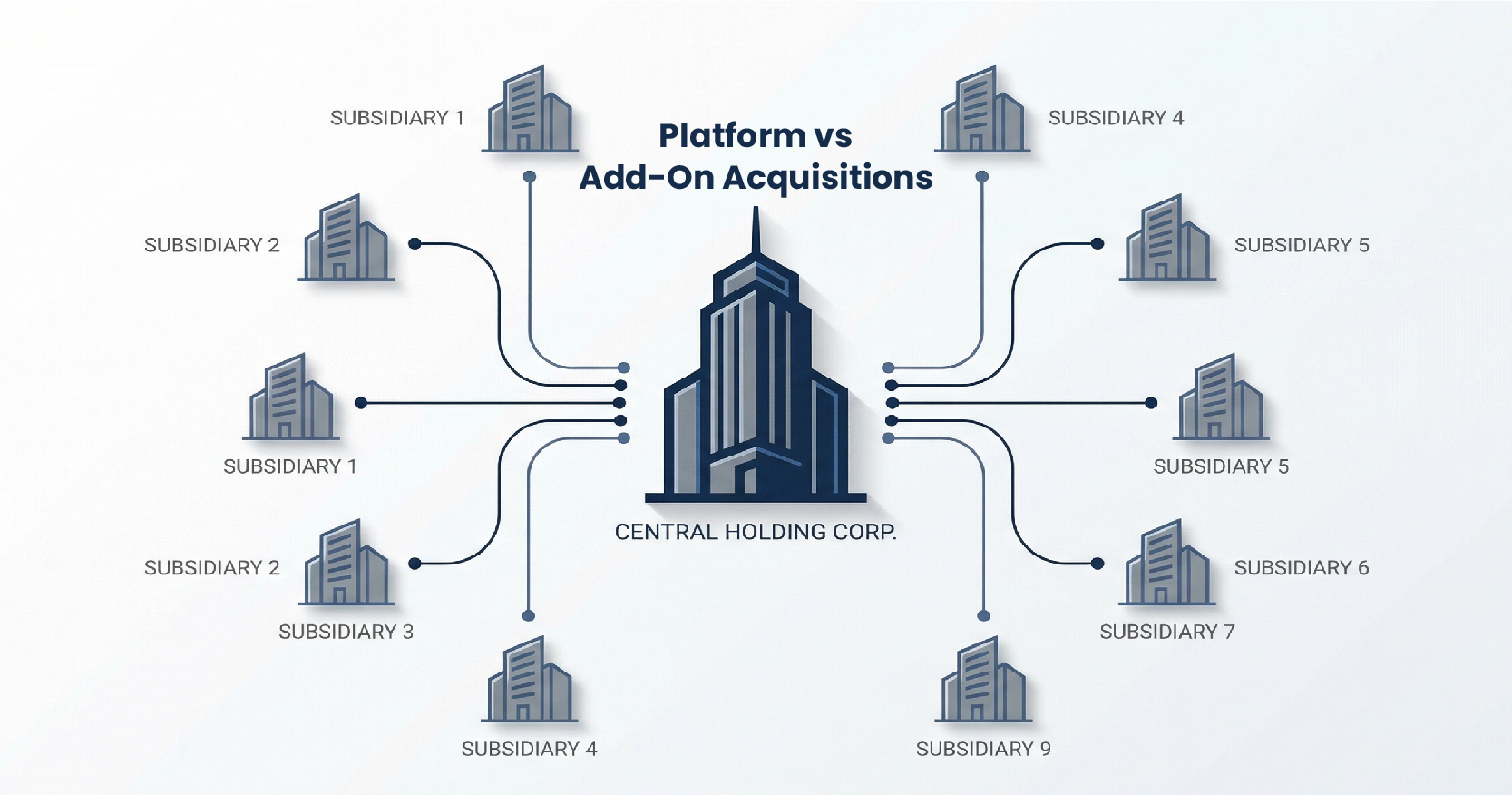
In private equity–backed M&A transactions, companies are often acquired as either platform investments or add-on acquisitions. A platform company serves as the primary investment that forms the foundation for future growth and acquisitions, while add-on acquisitions are smaller businesses acquired to expand that platform’s capabilities, market reach, or operational scale. For business owners planning to sell, understanding whether your company is viewed as a platform or an add-on can significantly influence valuation, deal structure, and your role after the transaction.
Why This Distinction Matters in Mid-Market M&A
Private equity firms are among the most active buyers in the mid-market.
Their investment strategies frequently rely on “buy-and-build” models, where one company is acquired as the foundation for future growth and additional acquisitions are added to expand the platform.
For sellers, this distinction affects several aspects of the transaction, including:
- valuation multiples
- management expectations
- deal structure
- future ownership opportunities
Many business owners do not initially realize whether buyers see their company as a platform opportunity or an add-on target, yet this perception can shape the entire transaction.
What Is a Platform Acquisition?
A platform acquisition is the initial investment a buyer makes in a particular industry or market segment.
The platform company typically serves as the foundation for future acquisitions and growth initiatives.
Private equity firms usually select platform companies that already possess strong operational infrastructure and leadership teams capable of scaling the business.
Platform companies often have:
- established management teams
- scalable operations
- strong market positioning
- consistent revenue growth
- diversified customer bases
Because the platform will support future acquisitions, buyers expect the company to function as the central operating entity within the investment strategy.
What Is an Add-On Acquisition?
An add-on acquisition (also called a bolt-on acquisition) occurs when a buyer acquires a smaller company to integrate into an existing platform.
These acquisitions typically expand the platform’s capabilities or geographic reach.
Add-on acquisitions may provide:
- new customers or markets
- complementary products or services
- specialized technology
- operational efficiencies
Unlike platform acquisitions, add-on businesses are usually integrated into an existing organization rather than serving as the core operating company.
How Platform and Add-On Deals Differ
Understanding the key differences between these two transaction types helps sellers anticipate how buyers may evaluate their businesses.
| Factor | Platform Acquisition | Add-On Acquisition |
| Role in Strategy | Foundational investment | Expansion of existing platform |
| Valuation | Often higher multiples | Often slightly lower multiples |
| Management Expectations | Strong leadership required | Integration into platform leadership |
| Strategic Importance | Central to growth strategy | Supports platform expansion |
| Operational Independence | Usually maintained | Often integrated |
While platform acquisitions tend to command higher valuations, add-on acquisitions can still produce attractive outcomes depending on the buyer’s strategy.
Why Platform Companies Often Command Higher Valuations
Platform companies typically receive higher valuation multiples because they form the foundation of a buyer’s investment strategy.
Several factors contribute to this premium.
Leadership Infrastructure
Platform businesses usually include experienced management teams capable of leading growth initiatives and managing future acquisitions. To understand how leadership depth influences buyer decisions, meet our expert M&A advisors who work closely with business owners to strengthen management structures well before entering a sale process.
Buyers place significant value on leadership depth.
Operational Scalability
Buyers expect platform companies to support future expansion.
Companies with scalable processes, systems, and infrastructure are particularly attractive.
Market Position
Strong market positioning helps buyers use the platform as a base for industry consolidation.
Companies with recognizable brands or established reputations often become ideal platform investments.
Why Add-On Acquisitions Are Still Attractive
Although platform companies often command higher multiples, add-on acquisitions remain a critical component of many investment strategies.
For sellers, add-on transactions can still deliver compelling outcomes.
Add-on acquisitions often appeal to buyers because they can:
- accelerate revenue growth
- expand geographic reach
- add specialized capabilities
- improve operational efficiency
In many cases, buyers expect add-on companies to integrate into an existing platform that already provides leadership and infrastructure.
How Sellers Can Determine Their Position
Business owners often ask whether their company will be viewed as a platform or an add-on acquisition.
Several factors influence this classification.
Company Size
Platform acquisitions are typically larger businesses with sufficient scale to support additional acquisitions.
Smaller companies are more likely to be considered add-ons.
Management Team Strength
Businesses with strong management teams capable of operating independently are more likely to qualify as platforms.
Operational Infrastructure
Companies with robust systems, processes, and reporting capabilities are better positioned as platforms.
Strategic Capabilities
Businesses that offer unique technology, market access, or industry expertise may be attractive as either platforms or highly valuable add-ons.
How This Affects Sellers
Whether a company is viewed as a platform or add-on target influences several aspects of the transaction.
Valuation Expectations
Platform companies often receive higher valuation multiples because they anchor the buyer’s investment strategy.
Add-on acquisitions may receive slightly lower multiples but can still attract competitive interest.
Post-Transaction Roles
In platform acquisitions, founders and leadership teams often remain heavily involved in managing the broader organization.
In add-on acquisitions, founders may transition out more quickly as the company integrates into the platform structure.
Ownership Opportunities
Platform transactions often include opportunities for rollover equity, allowing founders to participate in future growth.
Add-on acquisitions may include similar structures depending on the buyer’s strategy.
The Importance of Buyer Targeting
Many sellers assume their company’s classification is fixed.
In reality, the same business may be considered a platform by one buyer and an add-on by another.
This is why targeting the right buyer universe is critical. Understanding the 7 buyer evaluation metrics that define your valuation is an essential starting point — these metrics directly influence whether buyers classify your business as a platform or add-on target, and how aggressively they compete to acquire it.
A well-managed sale process ensures the business is presented to buyers whose strategies align with the company’s strengths.
Conclusion: Positioning Matters in M&A
Platform and add-on acquisitions represent two different strategic approaches to business acquisitions.
For sellers, understanding how buyers view their company can shape expectations around valuation, deal structure, and post-transaction involvement.
Businesses that position themselves effectively-highlighting leadership strength, operational scalability, and strategic value-can attract stronger interest from both platform investors and add-on buyers.
For owners considering a sale, early preparation and thoughtful positioning can significantly influence the success of the transaction and the value ultimately realized. Book a confidential M&A consultation with Horizon M&A Advisors today to understand how buyers will classify your business, identify the right buyer universe, and design a sale process that maximizes your outcome.
Frequently Asked Questions
What is a platform acquisition in private equity?
A platform acquisition is the primary investment a private equity firm makes in an industry, forming the foundation for future acquisitions.
What is an add-on acquisition?
An add-on acquisition occurs when a buyer purchases a smaller company to integrate into an existing platform business.
Do platform companies receive higher valuations?
Often yes. Platform companies may command higher multiples because they serve as the central entity for future growth.
Can a company be both a platform and an add-on?
Yes. A company might serve as a platform for one buyer while functioning as an add-on for another, depending on the buyer’s strategy.