
The Ultimate Checklist for Attracting Private Equity Interest and Maximizing Valuation
Private equity (PE) firms today are more selective than ever. While deal activity has surged in sectors with strong fundamentals, PE firms only invest in companies that are truly “investment-ready.”
If you’re planning to sell your business – or even consider partial investment—you need to prepare your company long before the first conversation with a PE buyer.
This guide explains exactly what PE firms look for, how to present your business as low-risk and high-opportunity, and what steps you can take today to increase valuation, credibility, and buyer interest.
What Does “Investment-Ready” Mean for Private Equity?
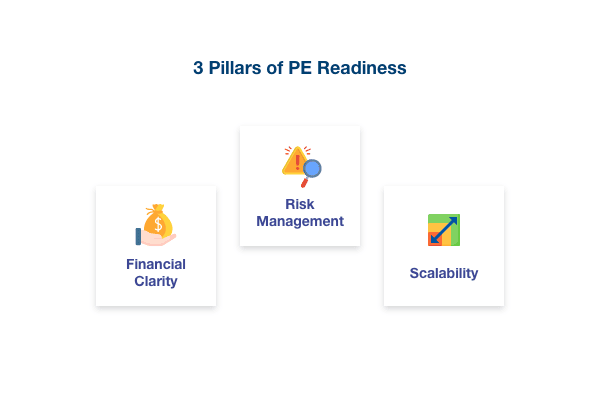
Being “investment-ready” means your business is:
✔ Financially transparent
✔ Operationally efficient
✔ Strategically scalable
✔ Low-risk
✔ Positioned for growth
In M&A terms, it means the business can pass private equity due diligence with confidence.
Why Being Investment-Ready Matters
PE firms compete aggressively for high-quality businesses—but only if the fundamentals are strong, clear, and reliable.
Becoming investment-ready can lead to:
- Higher valuation multiples
- Faster deal timelines
- Better deal structures
- Stronger buyer competition
- Reduced negotiation friction
Sellers who prepare early are statistically more likely to receive premium offers.
Step 1: Clean and Strengthen Your Financials
For PE firms, financial clarity is the foundation.
What Buyers Expect:
- Audited or reviewed financial statements
- Accurate EBITDA calculation
- Consistent monthly reporting
- Revenue breakdowns (recurring vs non-recurring)
- Clear cost structure and margins
Why It Matters:
PE firms rely on financial transparency to model returns and assess scalability. Any inconsistencies, missing documentation, or unclear reporting immediately signals risk.
Step 2: Demonstrate Stable and Predictable Revenue Streams
Buyers love predictable, contracted income.
Ways to Strengthen Predictability:
- Increase recurring revenue (subscriptions, service contracts, retainer models)
- Improve customer retention
- Reduce churn
- Shift customers to long-term agreements
PE buyers pay significantly more for businesses with revenue visibility.
Step 3: Build a Strong, Capable Management Team
A company that relies heavily on the founder is high-risk for PE firms.
What Buyers Want:
- A leadership team that can run the company post-acquisition
- Defined roles and accountability
- A succession plan
- Proven operational discipline
Why It Matters:
Buyers invest in companies that can operate independently. A strong team raises valuations and reduces deal risk.
Step 4: Document Your Processes and Systems
PE firms want businesses that scale with structure, not chaos.
Prepare These Before a Deal:
- SOPs (Standard Operating Procedures)
- Process documentation
- Sales workflows
- Customer support systems
- Compliance and governance documentation
Businesses with well-documented systems appear more mature, more scalable, and less risky.
Step 5: Reduce Operational and Market Risks
Risk reduction directly increases valuation multiples.
Key Areas to Strengthen:
- Customer concentration (no single client > 20%)
- Vendor dependency
- Legal exposure
- Compliance gaps
- Cybersecurity risks
- Contractual liabilities
Risk mitigation is a major factor in private equity valuation modelling
Step 6: Build a Scalable Growth Plan That PE Firms Can Execute
PE buyers invest for growth, not maintenance.
Your Growth Plan Should Include:
- 3–5 year strategic roadmap
- Market expansion opportunities
- Product/service growth levers
- Technology upgrades
- Unit economics
- Cost optimization strategies
A clear, data-backed growth plan allows a PE firm to envision the value creation potential.
Step 7: Improve Key Metrics Before Entering the Market
Prioritize improvements that impact valuation:
- EBITDA margin improvement
- Working capital efficiency
- Churn reduction
- Pricing optimization
- Strengthening gross margins
- Diversifying revenue channels
Small optimizations can dramatically increase buyer interest.
Step 8: Prepare a Professional Deal-Ready Data Room
PE firms evaluate businesses systematically.
A clean, organized data room makes you appear professional and trustworthy.
Include:
- Financials
- Tax returns
- Contracts
- Customer lists
- Employee structure
- SOPs
- Compliance documents
- Business plans
A polished data room = faster due diligence + higher perceived quality.
Step 9: Get a Valuation and Exit-Readiness Assessment
Before approaching PE firms, understand:
- Your current valuation
- Which areas need improvement
- What premium you could command
- Your exit timeline
- Best-fit PE buyers
A professional M&A valuation prevents underselling and improves negotiation leverage.
Final Takeaway: Preparation = Higher Valuation + Faster Deals
PE firms reward businesses that are:
✔ Financially transparent
✔ Operationally efficient
✔ Scalable
✔ Low-risk
✔ Strategically positioned
If you prepare in advance, you can:
- Earn higher valuation multiples
- Attract more PE firms
- Close deals faster
- Structure better terms
- Reduce deal friction
Ready to Position Your Business as Investment-Ready?
If you’re planning to sell your business or attract private equity investment, now is the right time to prepare.
Request a confidential valuation and investment-readiness assessment today.
Our team will help you:
✔ Strengthen your financials
✔ Improve operational efficiency
✔ Build a PE-ready growth plan
✔ Reduce risk and increase valuation
✔ Connect with the right private equity buyersTake the first step toward maximizing your exit value — reach out to Horizon M&A today.