

Interest rates directly influence business valuations, buyer behaviour, deal structure, and exit timing. When rates rise, borrowing becomes more expensive, which can reduce acquisition leverage and pressure valuation multiples. When rates fall, capital becomes cheaper, often increasing buyer demand and competitive tension. For business owners planning to sell, understanding how interest rates impact M&A dynamics is critical to protecting value and structuring a successful exit.
Why Interest Rates Matter in M&A
Many business owners assume interest rates are a macroeconomic issue that only affects banks and investors. In reality, interest rates play a central role in mid-market M&A.
They influence:
- How much buyers can borrow
- How aggressively private equity firms compete
- What valuation multiples are sustainable
- How deals are structured
- How quickly transactions close
If you are asking, “Is it a good time to sell my business?” interest rate conditions are one factor—but not the only one—to evaluate.
How Interest Rates Affect Business Valuation and Deal Structure
1. Interest Rates and Valuation Multiples
The Core Mechanism
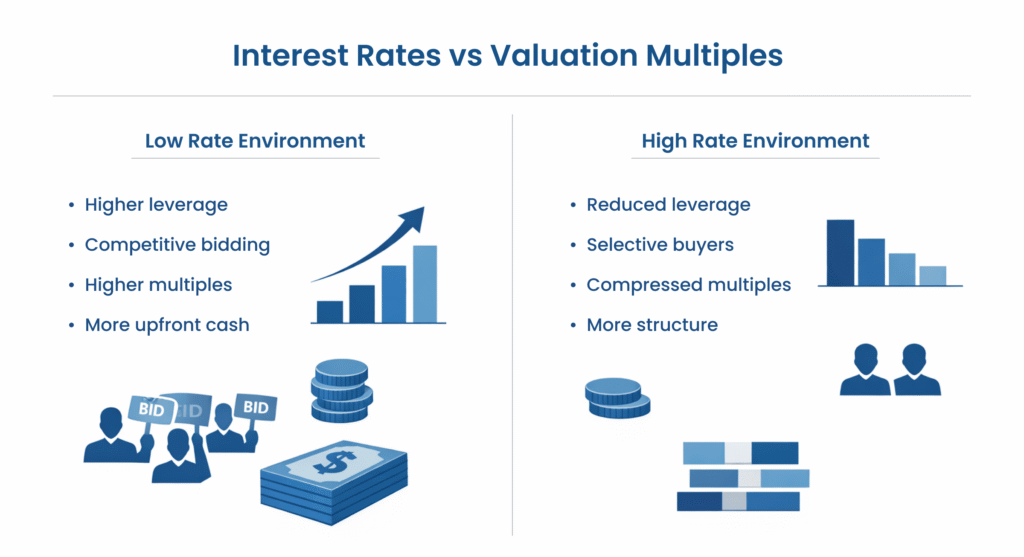
Most acquisitions—especially private equity transactions—use leverage (debt financing). When interest rates rise, the cost of debt increases. That reduces the amount buyers can afford to borrow while still meeting return targets.
When leverage declines, buyers often:
- Lower valuation multiples
- Increase equity contributions
- Add performance-based structures (earn-outs)
What This Means for Sellers
Higher interest rates can compress multiples, particularly for:
- Highly leveraged industries
- Lower-growth businesses
- Companies with volatile cash flow
However, high-quality businesses with strong recurring revenue and predictable margins may experience less impact.
Valuation is not determined by interest rates alone—but rates influence how aggressively buyers can bid.
2. Private Equity Behaviour in High-Rate Environments
Private equity plays a dominant role in mid-market acquisitions. Their model depends on using debt efficiently.
When Rates Rise
Private equity firms may:
- Tighten underwriting standards
- Focus on resilient, defensive industries
- Increase diligence depth
- Push harder on price
They may also rely more heavily on:
- Seller rollover equity
- Earn-outs
- Structured consideration
Seller Insight
In higher-rate environments, preparation becomes more important. Buyers become selective. The gap between strong and average businesses widens.
3. Deal Structure Changes When Rates Shift
Interest rate environments affect not just price but structure.
Common Shifts in Higher-Rate Markets
- More conservative leverage
- Larger escrow holdbacks
- Increased use of earn-outs
- Greater seller financing
Buyers look for ways to mitigate risk and preserve returns.
What Sellers Should Understand
Even if headline valuation holds steady, structure can materially affect net proceeds. Earn-outs, rollover equity, and seller notes shift risk back to the seller.
When selling a business, structure matters as much as price—especially when borrowing costs are elevated.
4. Strategic Buyers vs. Financial Buyers
Interest rates affect buyer types differently.
Financial Buyers (Private Equity)
More sensitive to interest rates due to leverage dependence.
Strategic Buyers
Often less sensitive because they:
- Use cash reserves
- Seek long-term synergies
- Focus on strategic expansion
In high-rate environments, strategic buyers may become more competitive relative to financial sponsors.
For sellers, understanding the buyer mix is critical when evaluating timing.
5. Buyer Psychology and Risk Tolerance
Interest rate environments influence market sentiment.
When rates are rising:
- Buyers become cautious
- Forecasts are scrutinized more heavily
- Downside scenarios carry more weight
When rates are stable or declining:
- Competitive bidding increases
- Growth assumptions become more flexible
- Risk appetite expands
Seller takeaway: in cautious markets, credible financial forecasting and risk mitigation drive stronger outcomes.
6. Does a High-Interest-Rate Environment Mean You Should Wait?
Many business owners ask:
- “Should I wait for interest rates to fall before selling my business?”
The answer depends on your company—not just the market.
Consider These Factors:
- Is your business performing strongly today?
- Are industry conditions favourable?
- Is your growth sustainable?
- Are there personal reasons driving a timeline?
Waiting for a “perfect” interest rate environment can backfire if performance softens or market conditions shift.
Prepared sellers often succeed in both high- and low-rate environments because buyers still compete for quality assets.
7. Industries Most Affected by Interest Rates
Not all sectors are equally sensitive.
More Rate-Sensitive Industries
- Capital-intensive businesses
- Real estate–related services
- Highly leveraged sectors
Less Rate-Sensitive Industries
- SaaS with recurring revenue
- Healthcare services
- Mission-critical B2B services
Buyers focus more on cash flow durability than macro headlines in resilient sectors.
Conclusion: Interest Rates Matter—But Preparation Matters More
Interest rates undeniably affect selling a business. They influence valuation multiples, buyer leverage, and deal structure. However, they are only one component of a successful exit.
For business owners considering a sale, focusing solely on interest rate timing can be a mistake. The more reliable strategy is early preparation, operational clarity, and thoughtful positioning.
If you are evaluating whether now is the right time to sell, a confidential conversation with an experienced M&A advisor can help you assess both market conditions and business readiness—so you can make an informed decision that protects value.
Frequently Asked Questions
How do interest rates affect business valuation?
Higher interest rates increase borrowing costs, which can reduce leverage and compress valuation multiples. Lower rates often expand buyer demand and competitive bidding.
Is it a bad time to sell when interest rates are high?
Not necessarily. Strong, well-prepared businesses can still attract competitive offers. Industry performance and company quality often matter more than rate cycles.
Do private equity firms stop buying when rates rise?
No. Private equity remains active but becomes more selective and disciplined in underwriting.
Should I wait for rates to fall before selling my business?
Waiting for better macro conditions can be risky if business performance declines. Exit timing should balance market conditions with company readiness.
How can I protect valuation in a high-rate environment?
Focus on improving cash flow predictability, reducing risk, strengthening management, and preparing thoroughly for diligence.