

Artificial intelligence is rapidly transforming how mergers and acquisitions (M&A) deals are evaluated. How buyers evaluate your business is changing fast – they are increasingly using AI-powered tools to analyze financial performance, identify risks, assess market trends, and accelerate due diligence. These technologies allow investors to review large volumes of data faster and uncover insights that traditional analysis might miss. For business owners preparing to sell, this shift means buyers are becoming more data-driven, more precise in risk assessment, and more disciplined in valuation decisions.
How Technology Is Reshaping M&A Evaluation
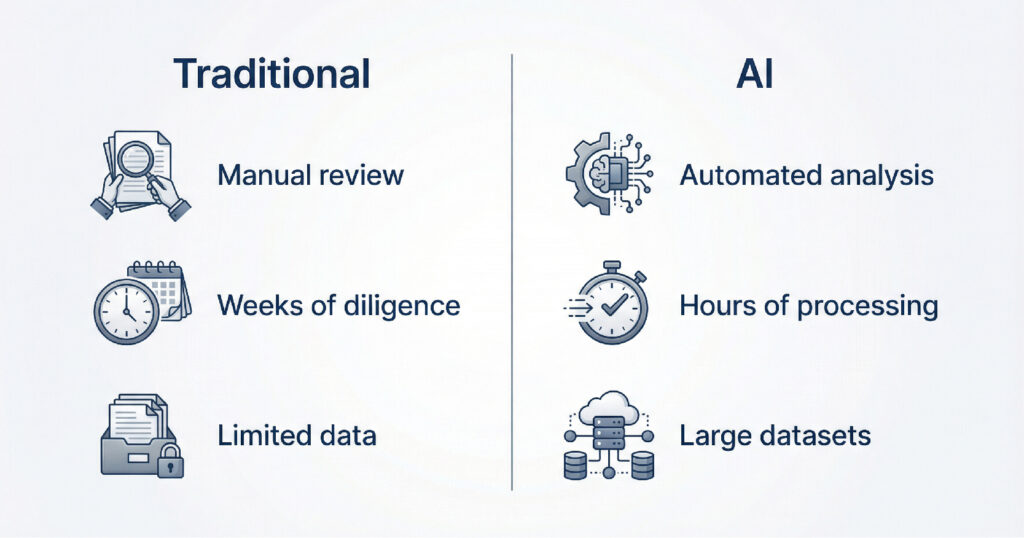
Historically, evaluating an acquisition opportunity required weeks of manual analysis.
Investment teams would:
- Review financial statements
- Conduct market research
- Interview management teams
- Analyze customer data
While these steps remain essential, artificial intelligence is dramatically accelerating the process.
AI tools can now analyze thousands of documents, financial records, and operational datasets in minutes rather than weeks.
For buyers, this creates several advantages:
- Faster deal screening
- More accurate risk identification
- Deeper financial insights
- More efficient due diligence
As a result, the M&A process is becoming more analytical and data-driven than ever before.
Where AI Is Already Transforming M&A
Artificial intelligence is not replacing human dealmakers. Instead, it is augmenting how they evaluate opportunities.
Several areas of the M&A process are already being influenced by AI technology.
1. Deal Sourcing and Market Scanning
One of the first steps in any acquisition strategy is identifying potential targets.
Traditionally, investors relied on:
- Industry networks
- Investment bankers
- Market reports
Today, AI-driven platforms can scan vast datasets to identify potential acquisition targets automatically.
These systems analyze:
- Industry growth trends
- Financial performance indicators
- ownership changes
- hiring patterns
- product launches
By detecting patterns across large datasets, AI can highlight companies that may be attractive acquisition opportunities.
For sellers, this means potential buyers may identify opportunities earlier than ever before.
2. Financial Analysis and Performance Evaluation
Financial evaluation is one of the most critical aspects of any transaction.
AI tools can now analyze financial performance across multiple dimensions simultaneously.
These systems can identify:
- margin fluctuations
- unusual revenue patterns
- working capital inconsistencies
- cost structure anomalies
Rather than reviewing spreadsheets manually, investors can use AI-powered models to uncover hidden trends in financial data.
For sellers, this means financial reporting must be clean, consistent, and transparent, because anomalies are easier for buyers to detect. This is especially important when preparing your business for sale – any inconsistencies in your financials that previously may have gone unnoticed are now far more likely to be flagged during diligence.
3. Due Diligence Automation
Due diligence has historically been one of the most time-consuming stages of an M&A transaction.
AI is significantly reducing the time required to review documents.
AI-powered diligence tools can analyze:
- contracts
- legal documents
- compliance records
- intellectual property filings
- customer agreements
These systems can flag potential issues such as:
- unusual contract terms
- legal risks
- missing documentation
This allows deal teams to focus on higher-level analysis rather than document review.
For sellers, organized data rooms and well-prepared documentation have become even more important.
4. Risk Detection and Pattern Recognition
AI excels at identifying patterns that may indicate risk.
By analyzing large datasets across multiple transactions, AI tools can detect signals that suggest potential problems.
Examples include:
- customer concentration risks
- declining retention trends
- operational inefficiencies
- unusual revenue recognition patterns
Because AI can compare companies against large industry datasets, buyers can benchmark performance more accurately.Understanding revenue-based business valuation is increasingly important here – AI tools are particularly adept at identifying how revenue quality and recognition patterns compare against industry benchmarks, often resulting in more disciplined valuation decisions.
5. Market Intelligence and Competitive Analysis
Another area where AI is influencing M&A evaluation is market analysis.
AI tools can analyze external data sources such as:
- industry reports
- competitor performance
- customer sentiment
- pricing trends
These insights help buyers understand the broader competitive landscape and assess whether a target company has sustainable advantages.
For sellers, demonstrating clear differentiation and defensible market positioning has become increasingly important.
How AI Is Changing Buyer Behaviour
As artificial intelligence becomes more widely adopted in M&A, buyer behaviour is evolving.
Several trends are emerging.
More Data-Driven Decision Making
Buyers now rely heavily on data analytics when evaluating deals.
Rather than relying solely on management presentations, investors increasingly validate claims using data-driven tools.
Faster Screening of Opportunities
AI allows buyers to review many more potential deals than before.
However, this also means companies are screened more quickly and rigorously.
If key metrics appear weak, buyers may decline opportunities earlier in the process.
Greater Emphasis on Data Quality
Because AI tools rely on structured datasets, businesses with strong data systems and clear reporting gain an advantage.
Companies with fragmented or inconsistent information may face greater scrutiny during diligence.
What Business Owners Should Do to Prepare
As AI becomes more integrated into M&A evaluation, business owners should focus on improving the quality and accessibility of their operational and financial data.
Key preparation steps include:
- Maintaining clean and consistent financial records
- Documenting operational processes clearly
- Organizing customer and revenue data
- Preparing comprehensive data rooms
- Tracking key performance indicators accurately
Businesses that present structured and transparent information make it easier for buyers to evaluate opportunities quickly.
This can increase buyer confidence and reduce transaction friction.
Conclusion: Data Transparency Is Becoming a Competitive Advantage
Artificial intelligence is changing how M&A deals are evaluated by enabling buyers to analyze companies more quickly and more thoroughly than ever before.
For business owners, the implications are clear: transparency, data quality, and operational clarity have become critical components of successful transactions.
Companies that prepare early and present structured information are more likely to attract serious buyer interest, maintain negotiating leverage, and achieve stronger exit outcomes.
Understanding how technology influences deal evaluation allows sellers to position their businesses effectively in an increasingly data-driven M&A environment.
If you are considering selling your business in the next 12–36 months, understanding how modern buyers evaluate companies is essential. Horizon M&A Advisors works with business owners to prepare financial data, organize diligence materials, and position companies effectively for today’s data-driven M&A environment.
A confidential conversation with our M&A advisory team can help you assess your readiness, identify potential valuation drivers, and ensure your business stands out when buyers begin their evaluation.
Frequently Asked Questions
Is AI replacing human decision-making in M&A?
No. AI assists investors by analyzing data more efficiently, but final decisions still rely heavily on human judgment and strategic considerations.
How does AI improve due diligence?
AI can review large volumes of documents quickly, identify potential risks, and highlight unusual patterns that require further investigation.
Will AI affect business valuations?
Indirectly, yes. AI allows buyers to analyse companies more precisely, which can lead to more disciplined valuations based on data rather than assumptions.
Should business owners invest in better data systems before selling?
Yes. Companies with clear financial reporting and organized operational data tend to experience smoother diligence processes and stronger buyer confidence.