
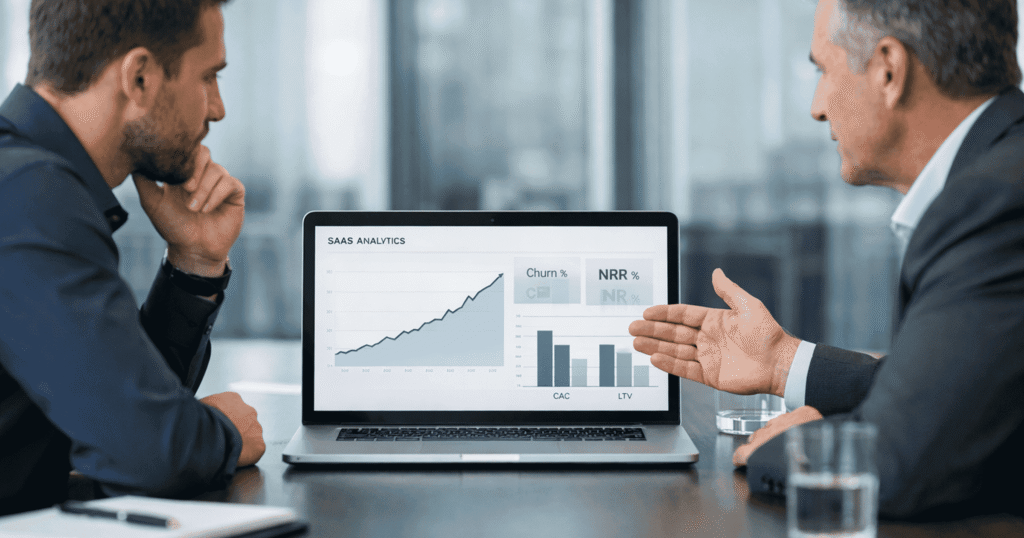
When acquiring a SaaS company, buyers focus on revenue quality, customer retention, scalable growth, unit economics, and operational predictability. Unlike traditional businesses, SaaS acquisitions are heavily evaluated on recurring revenue durability, churn rates, lifetime value, and product defensibility. For founders planning to sell, understanding these buyer priorities early can materially improve valuation, deal structure, and exit certainty.
Why SaaS Is Evaluated Differently in M&A
Selling a SaaS company is fundamentally different from selling a traditional services or manufacturing business. Buyers are not simply purchasing current profits—they are underwriting future recurring revenue streams.
In SaaS M&A, valuation is driven less by assets and more by:
- Predictable subscription revenue
- Customer retention and expansion
- Scalable infrastructure
- Growth efficiency
For SaaS founders asking, “How do buyers value SaaS companies?” the answer lies in revenue quality and future visibility-not just top-line growth.
How Buyers Value SaaS Companies: Key Metrics That Matter
1. Revenue Quality and Recurring Revenue
The first question buyers ask in any SaaS acquisition is:
How predictable is the revenue?
Buyers examine:
- Percentage of recurring vs. non-recurring revenue
- Annual Recurring Revenue (ARR) growth
- Monthly Recurring Revenue (MRR) consistency
- Revenue concentration
High-quality recurring revenue commands premium multiples because it reduces uncertainty.
What Reduces Value
- Heavy reliance on one-time implementation revenue
- Large customer concentration
- Short contract durations
- Unstable renewal patterns
Sellers preparing to exit should focus on strengthening subscription predictability well before going to market.
2. Customer Retention and Churn
Retention is often more important than growth.
Buyers closely analyse:
- Gross revenue retention (GRR)
- Net revenue retention (NRR)
- Logo churn vs. revenue churn
- Cohort performance
High net revenue retention—especially above 110%—signals strong product-market fit and up sell potential.
Why This Matters
A SaaS company growing 25% annually with high churn may receive a lower multiple than a company growing 15% with exceptional retention.
Retention reduces risk. Risk drives multiples.
3. Unit Economics and Customer Acquisition Efficiency
Buyers want to understand how efficiently growth is generated.
Key metrics include:
- Customer Acquisition Cost (CAC)
- Lifetime Value (LTV)
- LTV/CAC ratio
- Payback period
SaaS businesses with disciplined acquisition strategies and strong unit economics are seen as scalable. Those reliant on aggressive, unprofitable growth face valuation pressure.
For founders planning to sell a SaaS business, optimizing unit economics often increases exit value more than chasing unsustainable growth.
4. Growth Quality vs. Growth Speed
Growth still matters—but buyers distinguish between healthy growth and fragile growth.
They evaluate:
- Organic vs. inorganic growth
- Channel diversification
- Dependence on paid acquisition
- Pipeline visibility
Growth supported by strong retention, diversified channels, and expanding contracts receives stronger valuation support.
Growth driven by short-term marketing spend spikes does not.
5. Product Defensibility and Competitive Positioning
Buyers assess how defensible the product truly is.
They look for:
- Clear differentiation
- Switching costs
- Intellectual property
- Technical scalability
- Roadmap clarity
If customers can easily switch to competitors, future revenue becomes less certain.
SaaS companies with strong integrations, embedded workflows, and high switching costs are perceived as lower risk—and valued accordingly.
6. Technology Infrastructure and Scalability
Technology diligence is a major component of SaaS acquisitions.
Buyers evaluate:
- Code quality and architecture
- Technical debt
- Hosting environment and security
- Data privacy compliance
- Scalability of infrastructure
Outdated codebases or heavy reliance on key developers can create post-closing risk and reduce deal certainty.
Preparing technical documentation and addressing architectural weaknesses early can materially improve outcomes.
7. Management Team and Founder Dependency
In many SaaS businesses, founders play central roles in product, sales, and strategy.
Buyers assess:
- Depth of leadership team
- Sales management independence
- Product leadership continuity
- Succession planning
Excessive founder dependency often leads to:
- Longer earn-outs
- Mandatory transition periods
- Reduced upfront cash
Reducing owner dependency before launching a sale strengthens negotiating leverage.
8. Financial Discipline and Reporting Accuracy
Sophisticated SaaS buyers expect data clarity.
They scrutinize:
- Revenue recognition policies
- ARR reconciliation
- Deferred revenue treatment
- Gross margin trends
- Cohort reporting
Inconsistent reporting or unclear metrics create trust gaps during diligence.
Preparing clean financial statements and SaaS KPI dashboards is essential for smooth execution.
9. Deal Structure: Earn-Outs and Rollover Equity
In SaaS M&A, deal structure frequently includes:
- Earn-outs tied to ARR growth
- Rollover equity in private equity deals
- Performance-based milestones
While these can enhance total deal value, they also shift risk to the seller.
Founders should evaluate the structure carefully and understand that contingent consideration is not guaranteed proceeds.
Common Red Flags That Lower SaaS Valuation
Buyers frequently discount or walk away from SaaS acquisitions when they identify:
- Declining net revenue retention
- Customer concentration is above 20%
- Heavy technical debt
- Weak data security practices
- Aggressive revenue recognition
- Unsustainable marketing spend
Addressing these issues 12–24 months before selling can materially improve outcomes.
Conclusion: Preparing for a Successful SaaS Exit
Selling a SaaS company is about more than revenue growth. Buyers focus on predictability, retention, scalability, and disciplined execution.
Founders who understand what buyers look for in SaaS acquisitions—and prepare accordingly—command stronger valuations, negotiate better structures, and close with greater certainty.
If you are considering selling your SaaS business in the next 12–36 months, early preparation is the most reliable way to maximize value and control your outcome.
A confidential discussion with an experienced M&A advisor can help you assess readiness, identify value drivers, and position your company effectively before going to market.
Frequently Asked Questions
How do buyers value SaaS companies?
Buyers value SaaS companies based on recurring revenue quality, growth rate, retention metrics, unit economics, and scalability. Multiples vary depending on risk and predictability.
What increases SaaS valuation before a sale?
Improving net revenue retention, strengthening unit economics, diversifying customer base, and reducing founder dependency all increase valuation.
How important is churn in SaaS acquisitions?
Churn is critical. High churn signals product weakness and revenue instability, reducing valuation multiples.
Do SaaS founders need to stay after a sale?
Often, yes. Buyer expectations depend on management depth and product leadership continuity.
When should I start preparing my SaaS company for sale?
Ideally, 12–36 months before launching a process to improve metrics, reporting, and operational resilience.