
Understanding How Buyers Value a Business in 2025–26
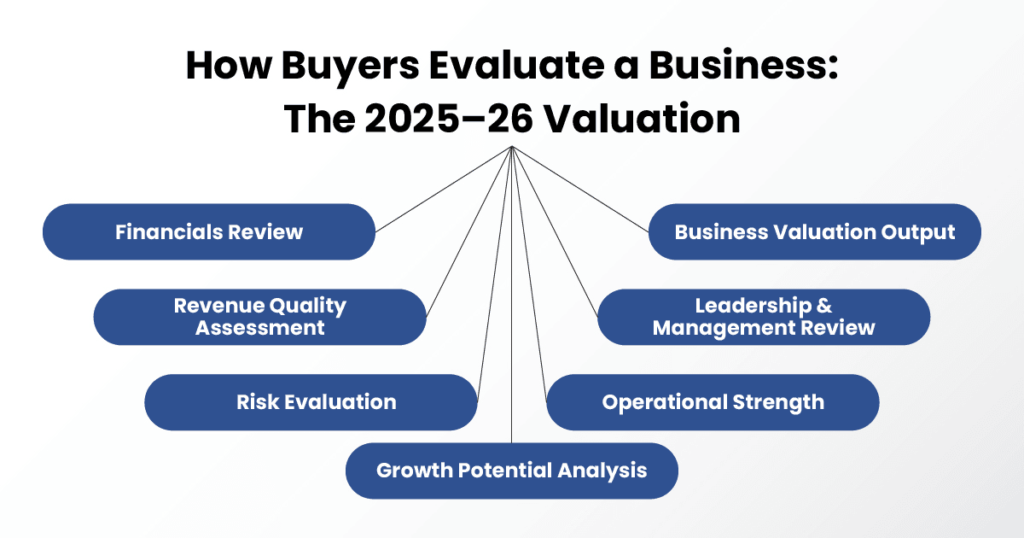
If you’re thinking of selling your business, the most important thing you can do is understand exactly how buyers evaluate companies today. In 2025–26, buyers are more sophisticated, more data-driven, and more selective than ever. Whether the buyer is a private equity firm, strategic competitor, or family office, they rely on a standard set of metrics to determine what your business is truly worth.
These evaluation metrics directly shape your valuation, your attractiveness to different buyers, and the number of offers you’ll receive. The good news? Once you understand these metrics, you can proactively improve your business and boost your value before entering the market.
Why Buyer Evaluation Metrics Matter for Sellers
Buyers use these metrics to assess:
- Financial strength
- Growth potential
- Operational efficiency
- Risk level
- Long-term stability
By learning what buyers look for, sellers can upgrade the right areas of the business and enter the market with confidence.
What Makes Today’s M&A Environment Different
From 2023 to 2025, M&A activity shifted dramatically. Buyers now use:
- AI-driven due diligence
- Behavior-based customer analytics
- Profitability benchmarking tools
- Industry-specific valuation models
This means sellers must present a clean, transparent, and well-prepared business to earn the highest valuation.
Metric #1: EBITDA & Adjusted EBITDA Strength
EBITDA remains the foundation of business valuation. Buyers analyse:
- Profitability
- Cash-generating ability
- Long-term financial stability
But in 2025–26, Adjusted EBITDA is even more important. This excludes one-time costs and owner-specific expenses to reveal true performance.
Normalized Profitability Trends
Buyers compare your last 3–5 years of profitability. They want to see:
- Stable EBITDA
- Healthy margins
- Predictability
EBITDA Margins Compared to Industry Benchmarks
Buyers analyse how your margins compare to similar companies. Higher-than-average margins can lead to premium valuation multiples.
Metric #2: Revenue Quality & Recurring Revenue
Not all revenue is equal. A company with predictable and repeatable sales is more valuable than one relying on one-time transactions.
Customer Retention & Contract Predictability
Buyers prefer:
- Multi-year contracts
- Recurring billing cycles
- Loyal customer base
Churn Rate and Long-Term Revenue Stability
Lower churn = stronger value. High churn signals instability or weak customer satisfaction.
Metric #3: Customer Concentration Risk
If one customer represents more than 15–20% of your revenue, buyers see this as a red flag. Heavy reliance on a small number of customers increases risk.
Diversification of Key Accounts
Buyers want:
- Broad customer base
- Multiple revenue streams
- Low dependency on any single relationship
Reducing concentration improves valuation and buyer confidence.
Metric #4: Cash Flow Health & Working Capital Efficiency
Cash flow is one of the most important valuation metrics in 2025–26. Buyers evaluate how efficiently your business turns sales into cash.
Cash Conversion Cycle Analysis
Shorter cycles create stronger valuations.
Seasonal Volatility & Cash Flow Patterns
Consistent cash flow signals stability and lowers buyer risk—leading to stronger offers.
Metric #5: Growth Rate & Future Scalability
Your business’s growth potential determines whether buyers view it as a safe investment or a high-return opportunity.
Year-over-Year Growth Trends
Buyers value:
- Consistent historical growth
- Predictable demand
- Strong industry tailwinds
Market Positioning & Industry Standing
A strong market position increases competitive value and can lead to higher acquisition multiples.
Metric #6: Operational Efficiency & Process Maturity
Efficient companies earn better valuations because they require less reinvestment and scale faster.
Technology & Automation Readiness
Buyers reward businesses with:
- Streamlined systems
- Automated processes
- Modern software usage
Organizational Structure Strength
A well-structured team reduces transition risk and improves scalability.
Metric #7: Management Team Depth & Owner Dependency
One of the first questions buyers ask in 2025–26:
Can this business run without the owner?
Leadership Continuity Post-Sale
Buyers want a management team that stays post-acquisition.
SOPs & Operational Independence
Strong standard operating procedures increase valuation because they prove the business can run smoothly under new ownership.
How Sellers Can Improve These Metrics Before Going to Market
Financial Cleanup Strategies
- Remove personal expenses
- Normalize financials
- Document profit adjustments
- Increase transparency
Strengthening Operational Systems
- Implement automation
- Create SOPs
- Reduce key-person dependency
- Improve reporting systems
These upgrades can significantly increase your selling price.
Conclusion: What Truly Defines Your Business Valuation
If you’re thinking of selling your business, these seven buyer evaluation metrics will play the biggest role in determining your company’s value. The more prepared you are—financially, operationally, and strategically—the stronger your valuation and the more competitive your offers will be.
A business that scores well across all seven metrics will always attract more interest, more credibility, and higher prices in the market.
Ready to see how your business performs across these seven metrics? Request a confidential valuation review today and discover your true market value.Contact Horizon M&A Advisors today